
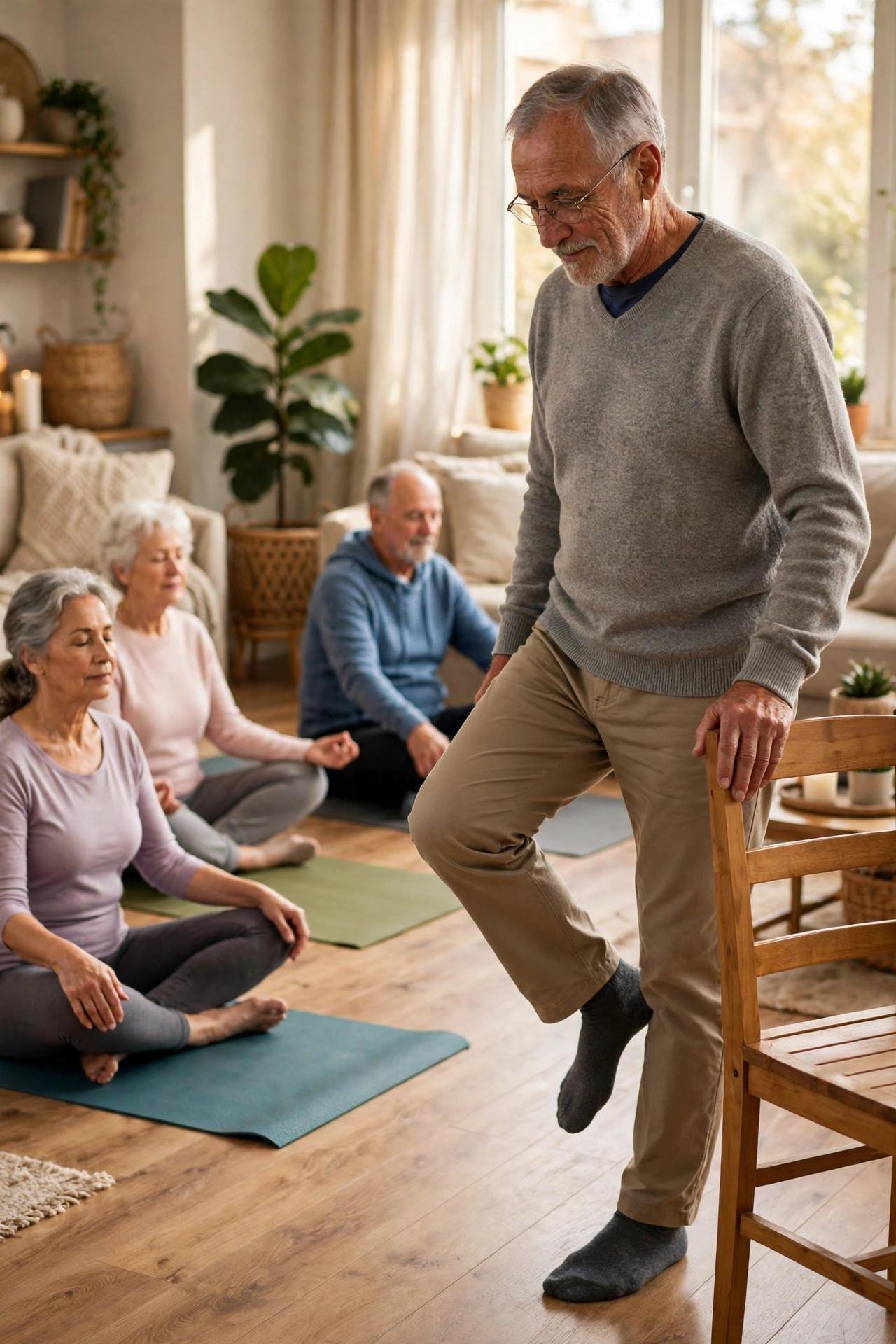
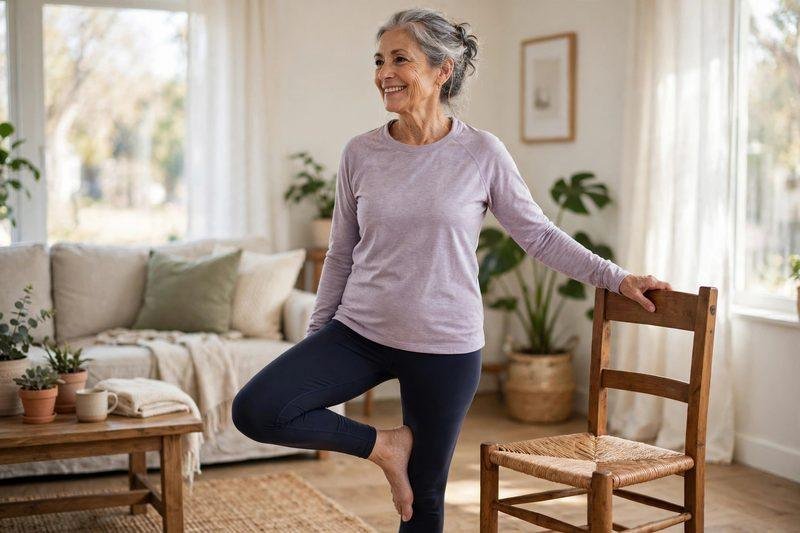
Introduction: Why Balance Deserves Its Own Practice
If you have ever grabbed a countertop to steady yourself, hesitated on a curb, or felt wobbly getting out of a chair, you are not alone. Balance changes as we age: leg muscles weaken a little, ankles stiffen, and reactions slow. None of this means you have to accept feeling unsteady. Balance is a skill, and it improves with gentle, regular practice.
Balance yoga for seniors is a calm, slow form of yoga built around steadiness rather than flexibility tricks or deep poses. You move slowly, you breathe normally, and you always keep support within reach. There is no floor work in this routine, no balancing on one leg with no help nearby, and no need to be flexible. If you can stand holding a chair, you can do this practice.
This 15-minute balance yoga for seniors routine is made for adults 60 and older, including complete beginners. It uses a sturdy chair and, where helpful, a wall. You will warm up your ankles and legs, practice standing tall, train your balance in small, safe steps, and finish with calm breathing.
This article is educational only and is not medical advice. Talk with a healthcare professional before starting any new exercise, especially if you have a heart condition, osteoporosis, vertigo, neuropathy, or a recent fall, surgery, or injury. Stop right away if you feel sharp pain, dizziness, chest discomfort, or unusual shortness of breath, and seek medical help if those symptoms do not pass quickly.
What Balance Yoga for Seniors Actually Is
Balance yoga for seniors is not about standing on one leg while someone watches. It is a set of slow, supported movements that train the three things balance depends on: leg strength, ankle mobility, and body awareness.
Leg strength matters because your legs catch you. When you stumble, your legs and hips make the quick correction that keeps you upright. Gentle yoga builds that strength gradually, using your own body weight rather than heavy weights or machines.
Ankle mobility matters because stiff ankles force the rest of your body to work harder. Simple ankle circles and heel raises wake up the small muscles around your ankles and help your feet respond to uneven ground.
Body awareness, sometimes called proprioception, is your sense of where your body is in space without looking. Slow yoga trains it because you move deliberately, feel your feet on the floor, and notice small shifts in weight before they become big wobbles.
A good balance yoga for seniors practice is slow, supported, and consistent. A chair or wall is smart training equipment, not a sign of weakness, and ten to fifteen minutes a few times a week beats one long, exhausting session.
How Balance Yoga May Help You Day to Day
- Steadier walking, especially on uneven ground, curbs, and grass
- More confidence standing up from a chair, getting out of bed, or stepping into a shower
- Stronger legs, ankles, and hips from gentle body-weight movement
- Better posture, because standing tall trains the muscles that hold you upright
- Looser ankles and calves, which helps your feet adapt to small changes underfoot
- Calmer breathing and less tension, since slow movement pairs naturally with slow breathing
- A practical way to notice changes early, so you can mention new unsteadiness to your doctor
These are everyday benefits, not promises, and they do not replace medical care, physical therapy, or a home safety check. If you have fallen more than once in the past year, tell your doctor even if you feel fine now, because falls often have a treatable cause.
Who Can Do This Routine, and How to Adapt It
This routine suits most adults 60 and older, including people who have never done yoga, people who use a cane or walker for longer walks, and people with stiff joints. You do not need to be flexible, thin, or fit. You need a sturdy chair, a clear space, and comfortable clothes.
Use a sturdy, armless chair with a flat seat that does not slide; a heavy kitchen or dining chair on a non-slip surface is ideal. Do not use a folding chair, a chair with wheels, a swivel chair, or a soft armchair that tips. Keep a wall nearby for the exercises that use one.
Wear flat, supportive shoes or non-slip socks, and skip loose slippers. Keep your phone within reach, keep water nearby, and practice when you feel alert and rested rather than tired or rushed. Morning or early afternoon often works best, when energy is higher and the floor is dry and well lit.
Adapt freely. If heel-to-toe feels too hard, keep your feet a little apart. If a pose makes your knees ache, bend them less or shorten the hold. If you need both hands on the chair the whole time, that is correct for you. A small wobble you correct yourself is good training; a big sway that scares you means you went too far, so step back to an easier version.
Take extra care if you have vertigo or inner-ear problems, get dizzy when standing, have severe osteoporosis, or are recovering from hip or knee replacement. Ask your doctor or physical therapist which parts fit you, and practice with another person nearby until you know how your body responds.
Safety First: Set Up Before You Start
- Put a sturdy, non-sliding chair beside you and a wall within reach
- Clear the floor of rugs that slide, cords, and clutter
- Wear flat shoes or non-slip socks, never loose slippers
- Keep water and your phone within reach
- Practice in good light, when you feel alert, not tired or rushed
- Breathe normally throughout; never hold your breath during a pose
- Move slowly, and keep a soft bend in your knees rather than locking them
- Stay near support at all times; keep at least one hand close to the chair or wall
- Stop if you feel sharp pain, dizziness, chest discomfort, or unusual breathlessness
- Talk with a healthcare professional before starting, especially after a fall, surgery, or new diagnosis
A useful habit for beginners is the “one-hand rule”: during any standing balance exercise, keep one hand resting lightly on the chair. As confidence grows over weeks, try lifting that hand for a few seconds at a time, then putting it back. You are training your balance, not testing it.
Your 15-Minute Balance Yoga Routine, Step by Step
Do this balance yoga for seniors routine slowly, in order. The times are a guide, not a race. If an exercise feels uncomfortable, skip it today and try again next session.
Minutes 1 to 3: Warm Up Your Ankles and Legs
Stand beside your chair with one hand resting on it. Lift one foot slightly and draw ten slow ankle circles in each direction, then switch feet. Next, holding the chair, rise slowly onto the balls of both feet, hold for two seconds, and lower slowly. Repeat eight times. Finish by marching gently in place for one minute, lifting each knee only a few inches, keeping your hand near the chair.
Minutes 3 to 6: Mountain Pose and Weight Shifts
Stand tall in mountain pose: feet hip-width apart, knees soft, shoulders relaxed, arms at your sides, eyes looking straight ahead. Imagine a string gently pulling the top of your head toward the ceiling. Hold for 30 seconds, breathing normally, with a hand hovering near the chair.
Now practice weight shifts, the foundation of balance. Slowly shift your weight onto your right foot until your left heel feels light, hold for five seconds, then return to center. Repeat on the left side. Do five shifts to each side. Keep the movement small and controlled. You are teaching your body to notice weight changes and correct them early.
Minutes 6 to 9: Heel-to-Toe Walking Along the Chair
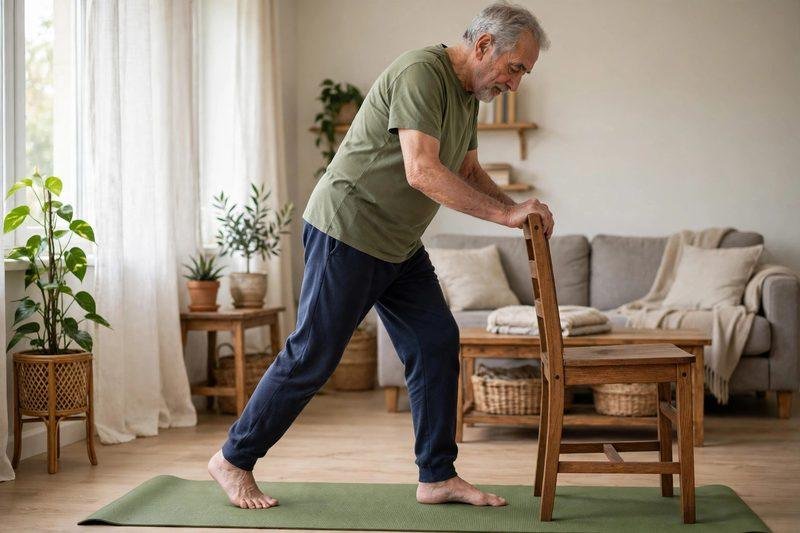
Stand beside your chair, with one hand resting lightly on the chair back. Place one foot directly in front of the other, heel touching toe, as if you were walking along a straight line. Hold for ten seconds, then step forward with the other foot and hold again. Take six slow steps this way, staying beside the chair the whole time.
If heel-to-toe feels too narrow, walk with your feet a few inches apart on an imaginary line instead. That is still excellent balance training. Keep your eyes forward, not down at your feet. If you wobble, pause, steady yourself on the chair, and continue.
Minutes 9 to 12: Chair-Supported Tree Pose
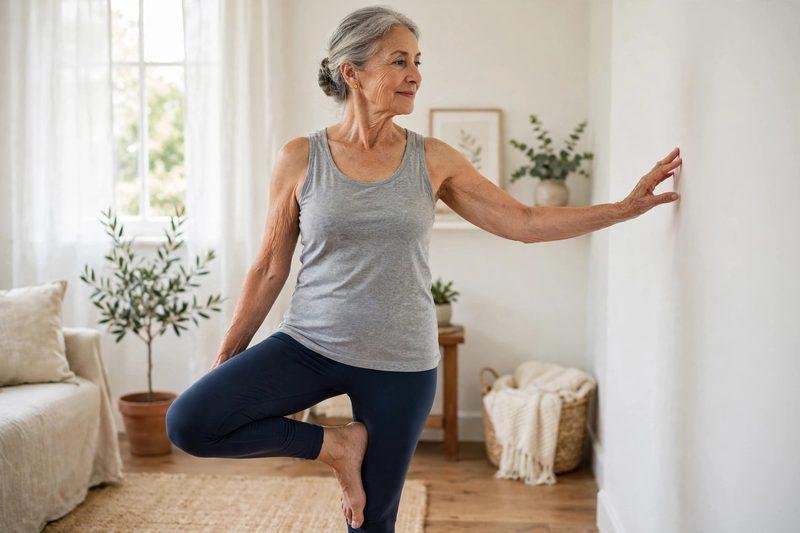
Stand beside your chair, one hand resting on it. Shift your weight onto your left foot. Slide your right foot a few inches to the side and rest the sole lightly against your left ankle, toes on the floor. This is a supported tree pose, and keeping your toes on the floor is the correct beginner version. Hold for 15 to 20 seconds, breathing calmly, then switch sides. Repeat twice on each side.
When this feels steady for a couple of weeks, try lifting the toes slightly so only the ball of the foot touches the floor, still keeping your hand on the chair. Do not force your foot high onto your thigh or knee; a low, steady tree builds just as much balance with far less risk.
Minutes 12 to 14: Sit-to-Stand Strength
Sit near the front of your sturdy chair, feet flat on the floor, hip-width apart, arms crossed over your chest or hands resting on your thighs. Lean slightly forward, press through your feet, and stand up slowly. Pause, then sit back down slowly, controlling the descent rather than dropping. Repeat six to eight times.
Sit-to-stand trains the exact movement you use dozens of times a day, strengthening the thighs and hips that catch you when you stumble. If eight repetitions feel like too many, do four with good form.
Minute 14 to 15: Calm Breathing and Closing Stretch
Sit in your chair, feet flat, hands resting on your thighs. Breathe in slowly through your nose for a count of four, then breathe out slowly through your mouth for a count of four. Repeat four times. Then roll your shoulders gently backward five times and forward five times, and stretch your arms overhead only as far as feels comfortable. Notice how your feet feel on the floor and how steady you feel sitting tall. That quiet moment of noticing is part of the training.
Mistakes to Avoid
- Practicing on a slippery floor or in loose slippers, which adds risk without adding benefit
- Holding your breath during a pose, which raises blood pressure and makes you dizzy
- Locking your knees, which makes balance harder and strains your joints
- Looking down at your feet, which shifts your weight forward and increases wobble
- Skipping the warm-up, because cold ankles and calves react more slowly
- Copying a younger person’s high tree pose instead of using the safe low version
- Practicing when tired, rushed, or after a large meal, when balance is naturally worse
- Pushing through sharp pain or dizziness instead of stopping and resting
- Doing a long session once a week instead of short, regular sessions
- Practicing alone in a cluttered room with no chair or wall nearby
If you catch yourself making one of these mistakes, treat it as useful information, not failure. Adjust, and continue. Good balance training is mostly good habits repeated often.
How Often to Practice, and How to Track Progress
Practice balance yoga for seniors two or three times a week, on days that are not back to back at first. Fifteen minutes is enough. After two or three weeks, you can add a fourth session or extend the holds by five seconds, but only if the current version feels steady.
Track progress simply. Once a week, note how long you can hold the supported tree pose on each side, how many sit-to-stands feel comfortable, and whether heel-to-toe walking feels easier. Also notice everyday moments, like standing to cook without grabbing the counter. Those daily wins are the real measure.
Progress is rarely a straight line. Some days you will feel steadier, some days less so, especially after poor sleep or a cold. That is normal. What matters is the trend over four to six weeks. If you feel steadily worse, fall, or develop new dizziness, stop and talk with a healthcare professional rather than pushing through.
A Gentle Closing
Steadier feet come from small, supported practice repeated week after week. Start where you are, use the support without apology, and let confidence build slowly.
If you are new to yoga for seniors, you may also enjoy our beginner chair routine, which is done entirely seated. Learn more about our approach on the About page, and if you have a question about this routine or a suggestion for a future article, we would love to hear from you through the Contact Us page. For how we handle your information and the limits of educational content, please read our Privacy Policy and Disclaimer pages.
Begin today, gently, with your chair beside you. Your future self, stepping confidently across a room, will thank you.
Frequently Asked Questions
Can yoga improve balance in seniors?
Yes. Balance yoga trains the three things steadiness depends on: leg strength, ankle mobility, and body awareness. A 2016 review of trials in people aged 60 and over found that yoga-based exercise improved balance and mobility. The gains come from slow, supported practice repeated over weeks, not from one session, so a short routine a few times a week is the right approach.
Can yoga prevent falls in the elderly?
Yoga on its own has not been proven to prevent falls, but it is one of the balance and strength exercises that do reduce falls. A large review of exercise for older people found that balance and functional exercise programmes reduce the rate of falls by about a quarter. Yoga helps because it strengthens the legs and hips, improves posture, and teaches you to notice small shifts in weight before they become wobbles. Walking and strength work alongside yoga give the best protection.
Is yoga good for seniors?
For most seniors, yes. Gentle yoga combines strength, flexibility, and balance training with calm breathing, and it can be adapted with a chair or wall for almost any fitness level. Studies suggest it can improve balance, walking confidence, flexibility, and mood, and may support better sleep. As with any new exercise, talk with your doctor first if you have osteoporosis, a recent joint replacement, uncontrolled blood pressure, or a history of falls.
What is the best yoga for elderly beginners?
Gentle Hatha yoga or chair yoga is the best starting point. These styles move slowly, hold poses for a few breaths, and use a chair or wall for support. Avoid fast-moving classes such as power yoga or hot yoga, which assume more flexibility and balance than most beginners have. Look for a class or routine made for older adults, and tell the instructor about any joint pain, past injuries, or balance problems before you begin.
How often should seniors practice balance yoga?
Two or three times a week is a good starting point, with at least a day of rest between sessions at first. Fifteen minutes is enough. After two or three weeks, you can add a fourth session or hold each pose a few seconds longer, but only if the current version feels steady. If you feel steadily worse, fall, or develop new dizziness, stop and talk with a healthcare professional rather than pushing through.
The CDC notes that falls among adults 65 and older caused over 43,000 deaths in 2024, making falls the leading cause of injury death for that age group — yet falls can be prevented.