

Introduction: Why Mornings Feel Stiff
If your first steps of the day feel slower than the rest of it, you are not imagining it. After a night of lying still, joints stiffen, muscles cool down, and blood flow slows. Getting out of bed too quickly can leave you wobbly, and the first walk to the kitchen can feel like the hardest part of the day.
Morning stretches for seniors are a gentle answer to that stiffness. They are not a workout and not a flexibility contest. They are a slow, 10-minute sequence that warms up your joints, wakes up your muscles, and lets you start the day steadier and more comfortable.
This routine is made for adults 60 and older, including complete beginners and people who have never stretched regularly. It starts in bed, moves to a chair, and finishes standing with support nearby. Every move is slow, every stretch is mild, and you can do the whole thing in your pajamas before breakfast.
This article is educational only and is not medical advice. Talk with a healthcare professional before starting any new exercise, especially if you have arthritis, osteoporosis, vertigo, a heart condition, a recent fall, surgery, or injury. Stop right away if you feel sharp pain, dizziness, chest discomfort, or unusual shortness of breath, and seek medical help if those symptoms do not pass quickly.
What Morning Stretches for Seniors Actually Are
Morning stretches for seniors are slow, gentle movements that take each major joint through a comfortable range of motion. You stretch only until you feel a mild pull, never pain, and you hold each position for 15 to 30 seconds while breathing normally.
The key word is gentle. You are not trying to touch your toes, force a joint further than it wants to go, or bounce into a stretch. Bouncing, called ballistic stretching, can strain cold muscles and is exactly what this routine avoids. Every movement here is smooth, controlled, and easy to stop.
The morning stretches for seniors routine works in three stages. First, bed stretches loosen you up while you are still lying down, so your first stand of the day is safer. Second, seated stretches warm up your neck, shoulders, back, and legs while you are fully supported. Third, a few standing stretches beside a sturdy chair wake up your balance and leg muscles for walking.
Ten minutes is enough. Stretching longer does not help more, and a short routine you actually do every day beats a long one you abandon after a week.
How a Morning Stretch Routine May Help You Day to Day
- Less morning stiffness, especially in the neck, shoulders, back, hips, and ankles
- Steadier first steps, because your legs and ankles are warmed up before you walk
- Better range of motion for everyday tasks like reaching a shelf or turning to look behind you
- Improved circulation after a night of stillness, which helps your muscles feel ready
- Looser shoulders and neck, where tension from sleep tends to settle
- A calmer, more confident start to the day, instead of a stiff and rushed one
- An early daily check-in with your body, so you notice new pain or unsteadiness sooner
These are everyday benefits, not promises, and they do not replace medical care, physical therapy, or treatment for arthritis or any other condition. If stiffness suddenly gets much worse, a joint swells, or you feel new pain that does not ease, talk with your doctor rather than stretching through it.
Who Can Do This Routine, and How to Adapt It
This routine suits most adults 60 and older, including people with arthritis, people who use a cane or walker, and people who have never exercised regularly. You do not need to be flexible. You need a bed, a sturdy chair, and a wall or countertop within reach.
If standing feels unsteady, do the entire routine seated or in bed. The seated versions give you nearly all the same benefit with far less risk. If a particular stretch hurts a joint, skip it or shrink the movement. A small, comfortable stretch done daily helps more than a big one that leaves you sore.
Wear loose, comfortable clothing and flat, supportive shoes or non-slip socks. Keep a glass of water nearby and drink a little before you start, since your body loses water overnight. Practice in a warm room when you can, because cold muscles stiffen faster.
Take extra care if you have vertigo or inner-ear problems, get dizzy when you stand up, have severe osteoporosis, or are recovering from hip or knee replacement. Sit up slowly in stages, from lying to sitting to standing, and keep support within reach until you know how your body responds each morning.
Safety First: Before You Stretch
- Sit up slowly in stages: lie to sit, sit for a moment, then stand, so dizziness has a chance to show itself before you are on your feet
- Keep a sturdy chair, wall, or countertop within reach for every standing move
- Stretch only to a mild pull, never to pain, and never force a joint
- Breathe normally throughout; never hold your breath during a stretch
- Move slowly and smoothly, with no bouncing, jerking, or sudden twists
- Keep your knees slightly soft during standing stretches, never locked
- Stop if you feel sharp pain, dizziness, chest discomfort, numbness, or unusual breathlessness
- Talk with a healthcare professional before starting, especially after a fall, surgery, or new diagnosis
- Skip stretching on a morning when you feel ill, feverish, or unusually unsteady, and try again tomorrow
A useful rule for beginners is the “talk test”: if you cannot breathe and talk comfortably during a stretch, you are pushing too hard. Ease off until the stretch feels easy again.
Your 10-Minute Morning Stretch Routine, Step by Step
Do the morning stretches for seniors routine in order. The times are a guide, not a race. If a move feels uncomfortable, skip it today and try again tomorrow.
Minutes 1 to 2: Bed Stretches, Before You Stand
While still lying down, stretch both arms overhead and point your toes away from you, then flex your feet back toward you. Repeat three times. Next, pull one knee gently toward your chest, holding behind the thigh, not the knee, for 15 seconds, then switch legs. Finish with slow ankle circles, five in each direction on each foot.
These bed stretches warm up your joints before your feet ever touch the floor, which is the single best thing you can do for safer first steps. Sit on the edge of the bed for a moment before standing.
Minutes 2 to 4: Neck and Shoulder Release

Sit in your sturdy chair with both feet flat on the floor. Slowly tilt your right ear toward your right shoulder until you feel a gentle stretch on the left side of your neck. Hold for 15 seconds, breathing normally, then switch sides. Next, roll your shoulders backward five times, slowly, then forward five times.
Then reach both arms overhead, interlace your fingers if comfortable, and stretch gently upward for 15 seconds. If your shoulders are too stiff for the overhead reach, simply raise your arms as high as comfortable and hold there. The goal is a mild stretch, not a particular height.
Minutes 4 to 6: Seated Spinal Twist and Forward Fold
Stay seated. For the seated spinal twist, place your left hand on your right thigh, turn your upper body gently to the right, and look over your right shoulder. Hold for 15 seconds, return to center, and repeat on the other side. Keep the twist slow and small; you should feel a gentle stretch through your waist and upper back, not a wrench.
For the seated forward fold, slide to the front of the chair, feet flat, and hinge slowly forward from your hips, letting your arms hang toward the floor. Go only as far as feels comfortable, rest your hands on your knees if that is your limit, and hold for 20 seconds. Roll back up slowly, one vertebra at a time, and sit tall.
Minutes 6 to 8: Standing Side Stretch and Calf Stretch
Stand beside your chair with one hand resting lightly on it. For the standing side stretch, raise one arm overhead and lean gently to the opposite side until you feel a stretch along your ribs and waist. Hold for 15 seconds, return to center, and repeat on the other side. Keep your feet hip-width apart and your knees soft.
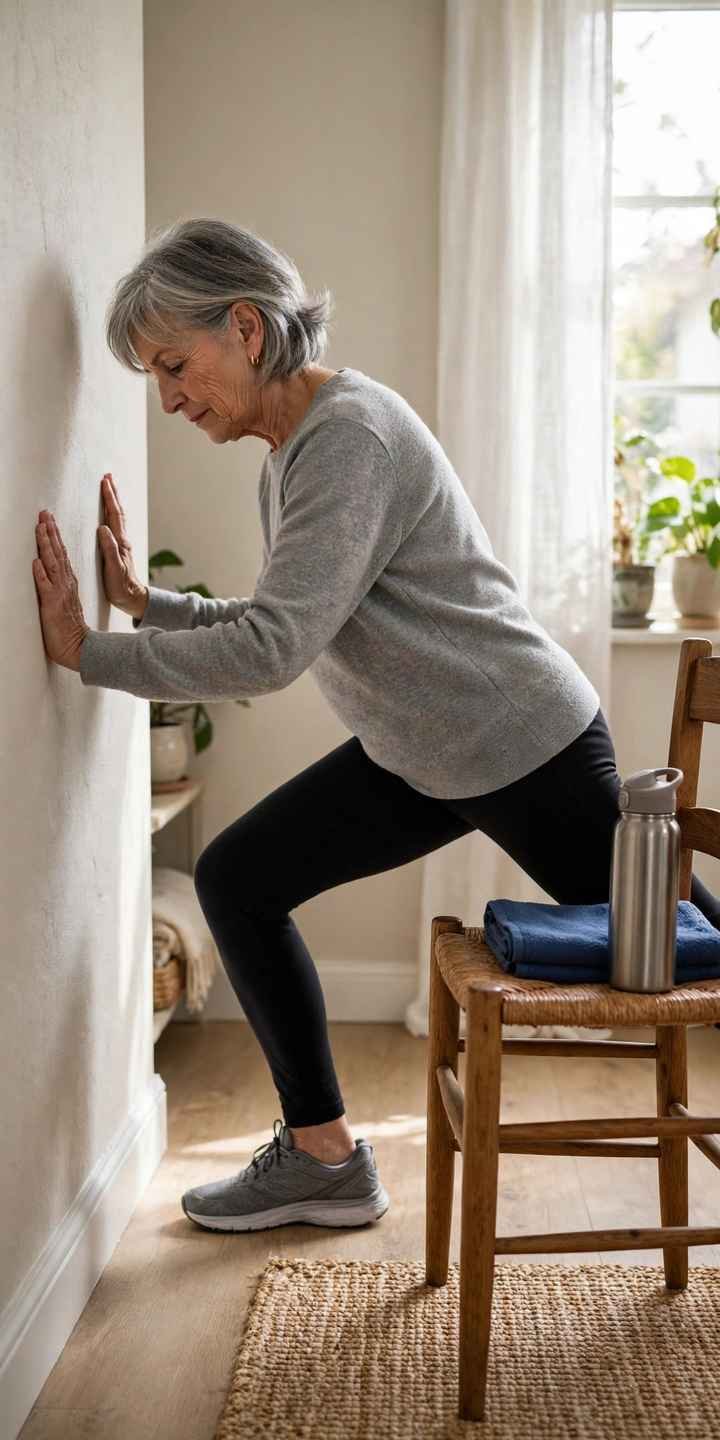
For the calf stretch, face the wall with both hands on it at shoulder height. Step one foot back, keeping that heel on the floor and the leg straight, and bend your front knee slightly until you feel a stretch in the back calf. Hold for 20 seconds, then switch legs. This stretch is especially useful if your calves feel tight first thing in the morning.
Minutes 8 to 10: Gentle Marching and Closing Breaths
Holding the chair lightly, march gently in place for one minute, lifting each knee only a few inches. This wakes up your hips and legs and gets blood moving before your first real walk of the day. If marching feels unsteady, simply shift your weight from foot to foot instead.
Finish seated. Breathe in slowly through your nose for a count of four, then breathe out slowly through your mouth for a count of four. Repeat four times. Notice how your body feels compared with when you woke up. That quiet moment of noticing is part of the routine.
Mistakes to Avoid
- Jumping out of bed and stretching cold, which is when muscles are most likely to protest
- Bouncing into stretches, which can strain muscles instead of loosening them
- Stretching into pain, or telling yourself pain means the stretch is working
- Holding your breath, which raises blood pressure and can make you dizzy
- Forcing a joint, especially the neck, with fast twists or deep bends
- Skipping the bed stretches and going straight to standing moves
- Locking your knees during standing stretches, which strains joints and hurts balance
- Doing the routine once a week for 30 minutes instead of a little every day
- Stretching on a cold, slippery floor in loose slippers
- Ignoring new or worsening pain instead of mentioning it to your doctor
If you catch yourself making one of these mistakes, treat it as useful information, not failure. Adjust, and continue. Good stretching is mostly good habits repeated often.
How Often to Stretch, and How to Track Progress
Do this morning stretches for seniors routine every morning. Ten minutes daily beats a longer session a few times a week, because morning stiffness returns overnight no matter how well you stretched yesterday.
Track progress simply. Once a week, notice whether your first steps feel easier, whether the seated forward fold goes a little further without effort, and whether your shoulders feel less tight by breakfast. Small changes over four to six weeks are the real measure. Flexibility improves slowly at any age, and it improves at all.
If progress stalls, that is normal too. Change one thing at a time: add five seconds to the holds, or add a second round of the calf stretch. If you feel steadily worse, fall, or develop new dizziness or pain, stop and talk with a healthcare professional rather than pushing through.
A Gentle Start to Every Day
Steadier mornings come from small, gentle morning stretches for seniors repeated every day. Start in bed, move slowly, use the support without apology, and let your body wake up at its own pace.
If you are new to gentle movement for seniors, you may also enjoy our beginner chair routine, which is done entirely seated, or our balance practice for steadier feet. Learn more about our approach on the About page, and if you have a question about this routine or a suggestion for a future article, we would love to hear from you through the Contact Us page. For how we handle your information and the limits of educational content, please read our Privacy Policy and Disclaimer pages.
Begin tomorrow morning, gently, before your feet hit the floor. Your first steps will thank you.
Frequently Asked Questions
What are the best morning stretches for seniors?
The best morning stretches are gentle, supported movements that start small and work through the whole body: ankle circles, shoulder rolls, a seated spinal twist, an overhead reach, a seated hamstring stretch, and a supported calf stretch. Start in bed or in a chair, and add standing moves only with a wall or chair nearby. Every stretch should feel like a mild pull, never pain, and you should breathe normally throughout.
How long should a morning stretch routine take?
Five to ten minutes is enough. That is plenty of time to loosen your ankles, spine, shoulders, hips, and calves without turning the morning into a workout. Stretching longer does not help more, and a short routine you actually do every day beats a long one you abandon after a week. If you are rushed or tired, even the first few moves count.
Should seniors stretch in bed, in a chair, or standing?
Start with whichever version feels safest before you are fully awake. Bed stretches are useful on very stiff mornings because your joints warm up before your feet ever touch the floor. Chair stretches reduce the balance demands and suit most people. Supported standing stretches help you transition into walking. You can do the entire routine seated or in bed and still get nearly all the same benefit with far less risk.
Is it better to stretch in the morning or evening?
Whichever time you will actually stick with. Morning stretching shakes off overnight stiffness and steadies your first steps, while evening stretching is a calm way to wind down for bed. If you can only manage one session a day, morning is the better choice for stiffness, because joints tighten again overnight. Some people do a short routine at both ends of the day, and that is fine too.
How often should seniors stretch?
Every morning is ideal, because morning stiffness returns overnight no matter how well you stretched yesterday. Ten minutes daily beats a longer session a few times a week. If daily feels like too much at first, start with four or five mornings a week and build up. Skip stretching on a morning when you feel ill, feverish, or unusually unsteady, and try again tomorrow.
The National Institute on Aging notes that flexibility is the ability of a joint to move through its full range of motion, and that stretching can help maintain and improve it.