
Introduction
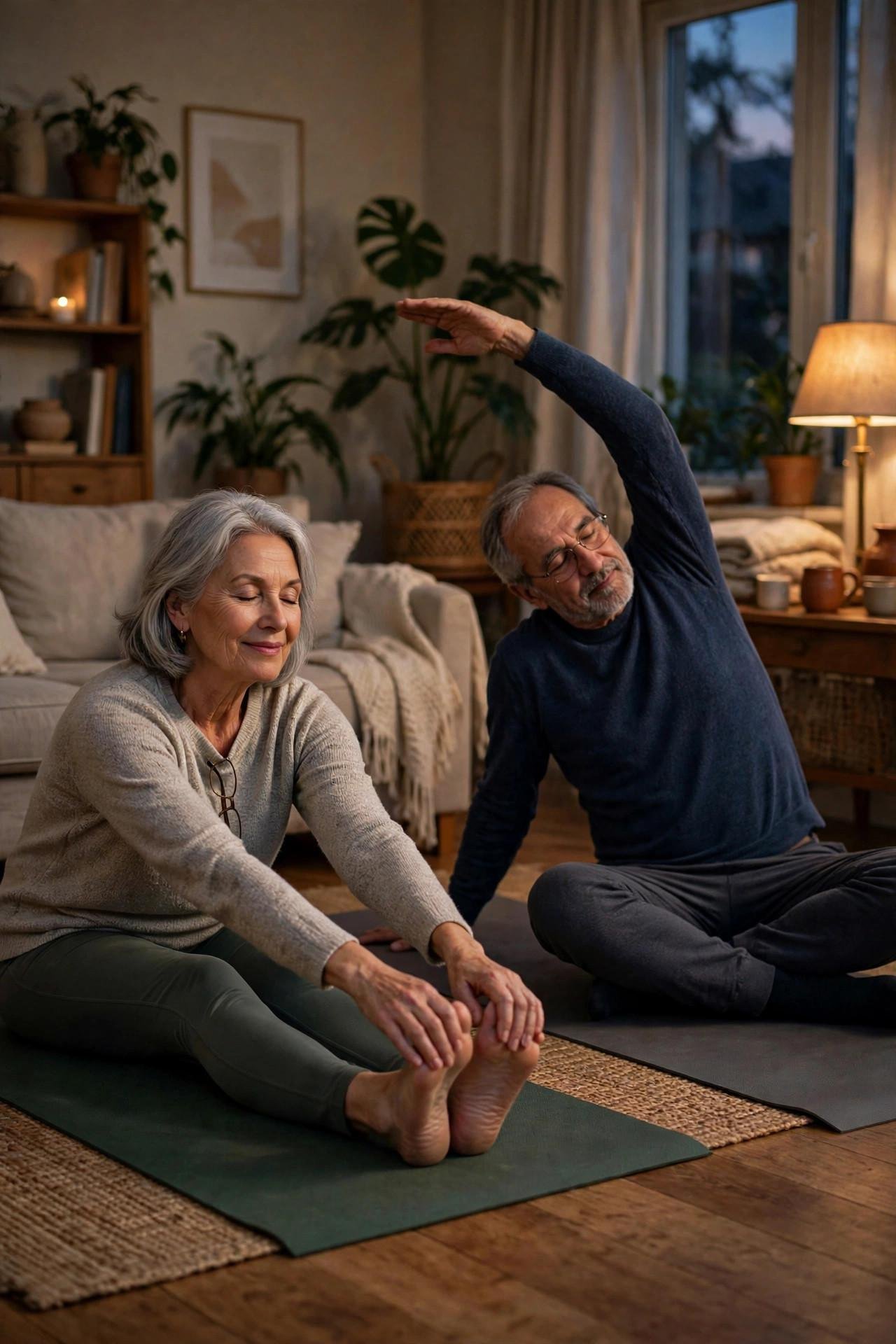
Evenings can feel like the hardest part of the day for many adults over 60. The day’s errands are done, the house grows quiet, and yet the body stays wound up: stiff knees, a tight lower back, restless legs, and a mind that keeps replaying the day. Evening yoga for seniors is a gentle way to close that gap between a busy day and a restful night.
This evening yoga for seniors routine takes about 15 minutes, needs no special flexibility, and can be done in a chair, on a mat, or in a mix of both. Every move is slow, supported, and easy to stop at any point. It is not a workout and it is not a test. It is simply a calm sequence that helps your muscles release, your breathing slow down, and your body get the message that the day is over and rest can begin.
What Is Evening Yoga?
Evening yoga for seniors is a slow, calming style of yoga practiced in the late afternoon or before bed. Unlike an energizing morning flow, it focuses on gentle stretches, long exhales, and supported resting poses. The goal is not to build strength or break a sweat. The goal is to let go of tension, quiet the mind, and prepare the body for sleep.
A good evening practice for seniors keeps three things in mind. First, everything stays close to the ground or close to a chair, so balance is never a worry. Second, every pose can be softened: bend the knees, use a cushion, or skip a move entirely. Third, the breath leads the movement. You move slowly on an inhale, settle on an exhale, and never force a stretch. You do not need to touch your toes or know any pose names.
Benefits of a Gentle Evening Practice
A short, regular evening routine can help in several practical ways:
- Eases the day’s stiffness. Gentle movement loosens hips, shoulders, and the lower back after hours of sitting, standing, or walking.
- Calms a busy mind. Slow breathing and simple, repeated movements give your attention something peaceful to follow instead of worries.
- Supports better sleep. A consistent wind-down routine signals to your body that bedtime is near, which can make it easier to fall asleep and stay asleep.
- Keeps joints moving. Moving each joint through a comfortable range every evening helps you stay mobile for everyday tasks like reaching, bending, and turning.
- Builds balance confidence. Slow, supported movements build body awareness, which carries over into steadier walking during the day.
- Creates a pleasant ritual. Fifteen quiet minutes that belong only to you can turn the end of the day into something you look forward to.
These benefits build with consistency, not intensity. Ten calm minutes most evenings will serve you far better than one long, strenuous session once in a while.
Who Can Do Evening Yoga?
Evening yoga for seniors is designed for adults 60 and older at almost any fitness level, including complete beginners. It works well if you sit for much of the day and feel stiff in the evening, have trouble winding down or falling asleep, want gentle movement but find regular exercise classes too fast, or feel unsteady on your feet (the chair version keeps you fully supported).
If you have a health condition, a recent surgery, or a joint replacement, talk with your healthcare professional before starting, and tell them you plan to do gentle seated and supported stretches. They can flag any movement to avoid. This article is educational only and is not medical advice.
Safety First: Gentle Rules for Every Evening
Safety comes before any pose. Keep these rules in place every time you practice:
- Move only to mild sensation, never pain. A gentle stretch is fine. Sharp, stabbing, or pinching pain means stop that move right away.
- Stop if you feel dizzy, short of breath, or have chest discomfort. Sit down, rest, and seek medical attention if the feeling does not pass quickly.
- Keep a sturdy chair nearby. Even for floor poses, a chair gives you something solid to hold while getting up and down.
- Never force a joint. If a knee, hip, or shoulder does not want to move in a certain direction, do not push it. Choose the chair version instead.
- Breathe normally. Never hold your breath during a stretch. If you cannot breathe comfortably in a pose, ease out of it.
- Practice on a non-slip surface. Wear socks with grips or go barefoot, and keep your mat or rug flat on the floor.
What You Need
You need very little, and you probably already own all of it: a sturdy, armless chair with a firm seat (a dining chair works well), a small cushion or folded towel for your lower back or knees, a blanket for the final resting pose, and comfortable, loose clothing. Optional but helpful: a yoga strap or a long scarf for supported leg stretches, and a wall nearby for the legs-up-the-wall resting pose. Start with the chair and a cushion, and add props only if you enjoy them.
The 15-Minute Evening Yoga Routine
Do this evening yoga for seniors routine about 30 to 60 minutes before bed, after your evening meal has settled. Move slowly, breathe through your nose when you can, and rest whenever you need to.
Minutes 0 to 2: Arrive and Breathe
Sit tall in your chair with both feet flat on the floor, hip-width apart. Place your hands on your thighs. Close your eyes if that feels comfortable, or soften your gaze toward the floor.
Breathe in slowly through your nose for a count of four, then breathe out slowly through your mouth for a count of six. Repeat this longer-exhale breathing five times. Longer exhales are the simplest way to tell your nervous system to slow down. Let your shoulders drop away from your ears and unclench your jaw. You are not trying to achieve anything in these two minutes except arriving in your body and leaving the day behind.
Minutes 2 to 4: Neck and Shoulder Release
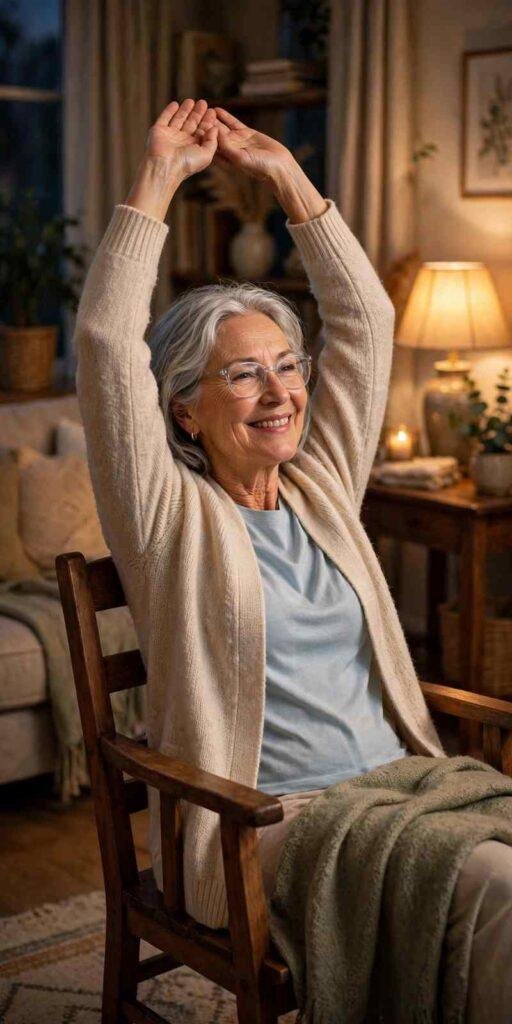
The neck and shoulders carry much of the day’s tension, especially after driving, reading, or sitting at a table. Drop your right ear gently toward your right shoulder, keeping the left shoulder relaxed and down. Hold for three slow breaths, then return to center and repeat on the left. Slowly turn your head to look over your right shoulder, hold for two breaths, then turn to the left. Roll your shoulders up toward your ears, back, and down in a slow circle, five times, then reverse the circle five times. Finish by lifting your arms overhead on an inhale, then letting them float back down on a long exhale. Keep every movement small and smooth. If a neck movement causes tingling in your hands or sharp pain, skip it.
Minutes 4 to 6: Seated Cat-Cow and Spinal Twist
For seated cat-cow, sit tall with your hands on your knees. On an inhale, gently arch your back, lift your chest, and look slightly upward. On an exhale, round your back, tuck your chin, and let your shoulders curl forward. Move back and forth slowly, six times, matching each movement to one breath.
For the seated spinal twist, keep both feet flat and your hips facing forward. Place your right hand on the outside of your left knee and your left hand on the chair behind you or on your hip. Inhale to sit tall, then exhale and turn gently to the left. Hold for three breaths, then return to center and repeat on the other side. Twists should feel like a gentle wringing out of the day, never a forceful yank.
Minutes 6 to 9: Gentle Hip Openers and Forward Fold
For the seated figure-four stretch, place your right ankle on your left knee, keeping the foot flexed to protect the knee. Sit tall and, if it feels comfortable, lean forward very slightly from the hips until you feel a gentle stretch in the right hip and outer thigh. Hold for four breaths, then switch sides. If the ankle-on-knee position is uncomfortable, simply cross your ankles and lean forward slightly instead.
For the seated forward fold, place both feet flat, wider than hip-width, with toes turned slightly out. Inhale to sit tall, then exhale and fold forward from the hips, letting your hands slide down your legs toward your ankles. Let your head hang heavy. Hold for four breaths, then press your hands into your thighs to rise slowly. Never bounce or force the fold. Even a small forward movement counts.
Minutes 9 to 11: Supported Leg Stretch and Ankle Circles
Stay seated and extend your right leg forward, heel on the floor, toes pointing up. Gently flex and point the foot five times, then draw slow ankle circles five times in each direction. This simple move wakes up circulation in the lower leg and eases that restless feeling.
For a supported hamstring stretch, loop a scarf or strap around the ball of your right foot, hold both ends, and gently straighten the leg as much as is comfortable, keeping a soft bend in the knee. Hold for three breaths, then switch sides. If you do not have a strap, rest the heel on a low stool and lean forward slightly. Finish by marching gently in place while seated, lifting each knee a few inches, ten times per side.
Minutes 11 to 13: Calming Breath and Seated Meditation
Return to stillness. Sit tall, hands resting in your lap, eyes closed or softly lowered. Practice simple box breathing: breathe in for four counts, hold gently for four counts, breathe out for four counts, and rest for four counts before the next breath. Repeat four rounds. If holding the breath feels uncomfortable, skip the holds and simply breathe in for four and out for six.
Minutes 13 to 15: Resting Pose and Slow Close
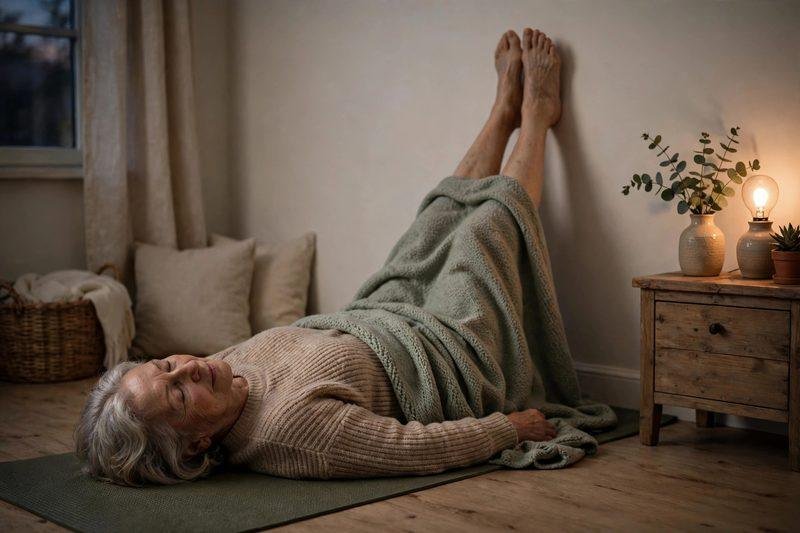
End with a resting pose. If getting to the floor is easy for you, lie on your back with your legs up the wall or bent over a cushion, arms relaxed at your sides. If the floor is difficult, simply lean back in your chair with a blanket over your lap, feet flat, and hands resting open.
Rest here for two full minutes, breathing naturally and letting your muscles feel heavy. When the two minutes are done, wiggle your fingers and toes, roll gently to your side if you are on the floor, and sit up slowly. Rise carefully, using the chair for support.
How Often Should You Practice?
Aim for most evenings, five to seven days a week if you enjoy it. The routine is gentle enough for daily practice, and regularity is what turns it into a reliable sleep cue. If daily feels like too much, start with three evenings a week and add a night whenever it feels easy. If you miss an evening, simply return the next night. There is no streak to protect and no penalty for a missed day. Evening yoga works because it is pleasant, not because it is perfect.
A Gentle Closing
Evening yoga for seniors is not about becoming flexible or athletic. It is about giving your body a kind, predictable way to end the day. Fifteen minutes of slow breathing, gentle stretches, and quiet rest can turn a restless evening into a peaceful one, night after night.
Start tonight, if you like. Dim the lights, sit in your sturdy chair, and take five slow breaths with a longer exhale. That alone is a beginning. Add the rest of the routine as it feels comfortable, and let your evenings become something you look forward to.
If you found this routine helpful, you may also enjoy our gentle morning stretches and our chair yoga routine for seniors, and you can learn more about this site on our About page, reach us through our Contact Us page, or read our Privacy Policy and Disclaimer.
Frequently Asked Questions
What is the best time to do evening yoga for better sleep?
About 30 to 60 minutes before bed, after your evening meal has settled, works well for most people. Practicing one to two hours before bedtime is also fine. The key is to keep the practice slow and calming, so your body gets the message that rest is near. Avoid vigorous or fast-moving yoga close to bedtime, as it can raise your energy and make sleep harder.
Can evening yoga help with sleep problems in older adults?
Yes, it can help. Gentle yoga lowers stress, slows breathing, and relaxes tense muscles, all of which make it easier to fall asleep and stay asleep. Research on older adults links regular yoga with better self-reported sleep quality. It is not a treatment for insomnia or sleep apnoea, so if sleep problems persist for weeks, talk with your doctor — but as part of a regular wind-down routine, it is a genuinely useful tool.
Which yoga poses should I avoid before bed?
Avoid anything energising: deep backbends, inversions such as headstands, and fast-flowing sequences that raise your heart rate. These can leave you feeling more awake instead of sleepy. Before bed, stick to seated or supported stretches, gentle twists, forward folds, and resting poses such as legs up the wall. If you notice you feel more alert after practice, the session was probably too late or too intense — switch to slower breathing and stillness.
Which style of yoga is best before bed for seniors?
Gentle, slow styles are best: restorative yoga, yin yoga, or gentle Hatha. These focus on long, supported holds and slow breathing rather than strength or sweat. Avoid vigorous styles such as Ashtanga or power yoga in the evening, as they are too stimulating before sleep. The routine on this page follows the restorative pattern — everything stays close to a chair or the floor, and the breath leads the movement.
How often should I do evening yoga?
Most evenings is ideal — five to seven nights a week if you enjoy it. The routine is gentle enough for daily practice, and regularity is what turns it into a reliable sleep cue. If daily feels like too much, start with three evenings a week and add a night whenever it feels easy. If you miss an evening, simply return the next night; there is no streak to protect.
The National Institute on Aging notes that older adults need seven to nine hours of sleep each night, and that a relaxing bedtime routine is one of its recommended ways to get there.