
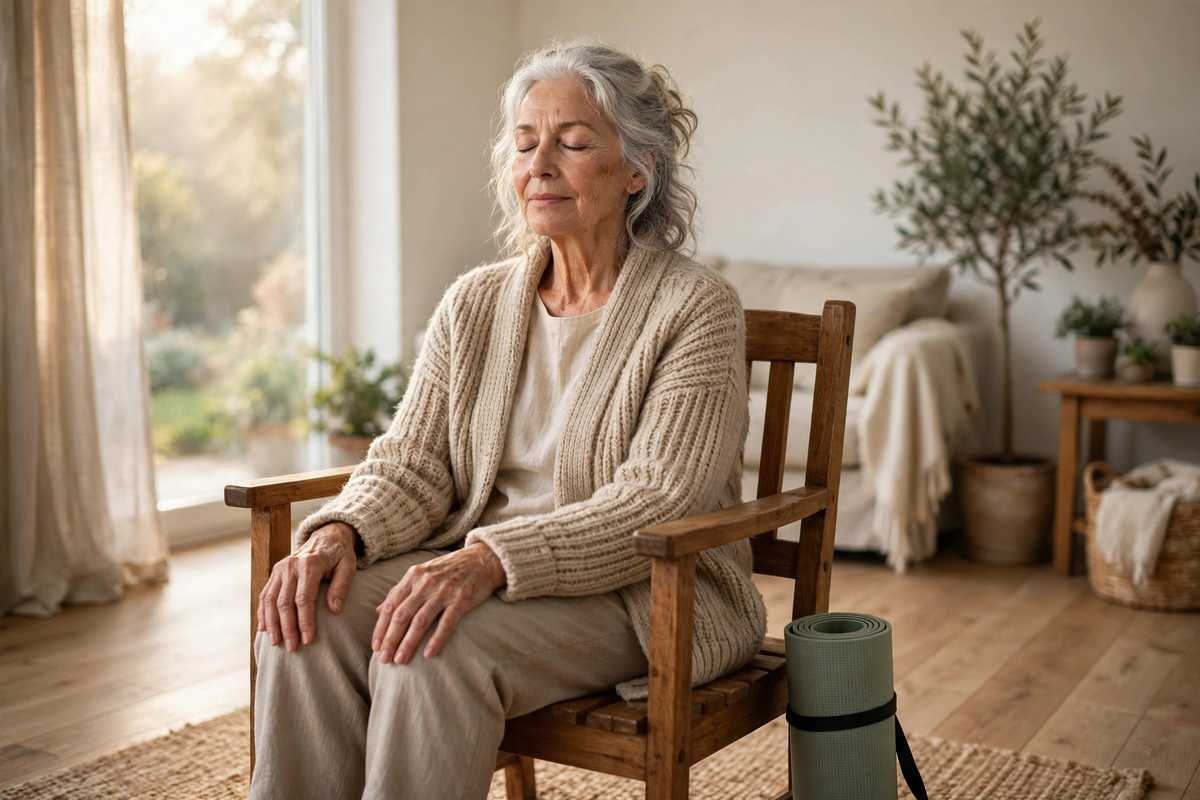
Yoga for Older Adults: A Gentle 20-Minute Stress Relief Routine
Stress does not retire when you do. Money worries, health news, an empty house after the kids move out, a spouse who needs more care every year — the list changes, but the tight shoulders and the 3 a.m. staring at the ceiling stay the same. Yoga for older adults works for stress relief because it does two things at once: it loosens the muscles where stress settles, and it slows the breathing that stress speeds up. You do not need to be flexible. You do not need a studio. You need a chair, a mat or a rug, and 20 quiet minutes.
This guide is for adults over 60 who want a calm, practical routine they can do at home. Everything here is gentle. Nothing here asks you to twist into a shape, hold your breath until you feel dizzy, or push through pain. If a pose hurts, you skip it. That is the rule, not a failure.
What Stress Does to an Older Body
Stress is not only a feeling. When you worry, your body releases cortisol, a hormone that raises blood sugar, tightens muscles, and keeps your heart rate up. A short burst is normal. Weeks and months of it are not. High cortisol over time is linked to poor sleep, higher blood pressure, weaker immunity, and more aches in the neck, shoulders, and lower back.
Here is the part most articles skip: after 60, your body clears cortisol more slowly than it did at 40. The same worry lingers longer in your system. That is why a stressful phone call in the morning can still leave your shoulders up around your ears at dinner. Slow breathing and gentle movement are the fastest everyday tools for bringing cortisol back down, because they switch your nervous system from its alert mode into its rest mode. A 2025 analysis of 44 trials found yoga lowered cortisol more than any other form of exercise studied. That is not a promise that yoga cures anything. It is a reason to try 20 minutes and see how you feel afterward.
What This Routine Gives You
- Shoulders, neck, and jaw that actually let go by the end of the session
- Slower, deeper breathing you can use later in the day when stress spikes
- A calmer evening and an easier time falling asleep
- Less stiffness in the hips and lower back, which is where tension hides for many seniors
- A simple routine you can repeat daily without getting bored or sore
Safety First
Talk with your doctor before starting any new exercise, especially if you have high blood pressure, heart disease, glaucoma, a recent surgery, severe osteoporosis, or balance problems. This article is educational only. It is not medical advice, and it does not replace your doctor’s guidance.
Stop right away and rest if you feel sharp pain, dizziness, chest discomfort, or shortness of breath. Mild stretching is normal. Pain is a signal, not a challenge. Keep a sturdy chair within reach for every standing pose, and keep your phone nearby the first few times you practice alone.
One more safety point: never hold your breath during these poses. If a breathing pattern makes you lightheaded, go back to normal breathing at once. The breathing exercises below use slow, comfortable breaths only — no long holds.
The Breathing Comes First, Not Last
Most guides to yoga for older adults put breathing at the end, like an afterthought. That is backwards. Breathing is the tool that calms you; the poses just give the breath somewhere to go. So we start with two minutes of breathing before any pose.
Belly breathing (2 minutes). Sit in your chair with both feet flat on the floor. Put one hand on your belly. Breathe in through your nose for a slow count of 4 and feel your belly rise under your hand. Breathe out through your mouth for a slow count of 6 and feel it fall. That longer exhale is the part that tells your nervous system to stand down. Do 8 to 10 breaths. If counting to 6 on the exhale feels hard, use 4 in and 5 out. The exact numbers matter less than the slow, steady rhythm.
Box breathing (optional, 1 minute). If your mind is racing, try this: breathe in for 4, hold gently for 4, breathe out for 4, rest for 4. Repeat 4 times. Skip the hold entirely if it makes you uneasy — a 4-in, 4-out rhythm without any hold still works.
Use belly breathing again any time during the day when stress spikes — in a waiting room, on a phone call, before bed. It is the single most useful piece of this whole routine, and it costs nothing.
The 7 Poses: Slow, Seated and Standing
Each pose below has an exact hold time. Move slowly between poses. There is no rush, and rushing is the one thing that defeats the whole point.
1. Seated Neck Release — 30 Seconds Each Side
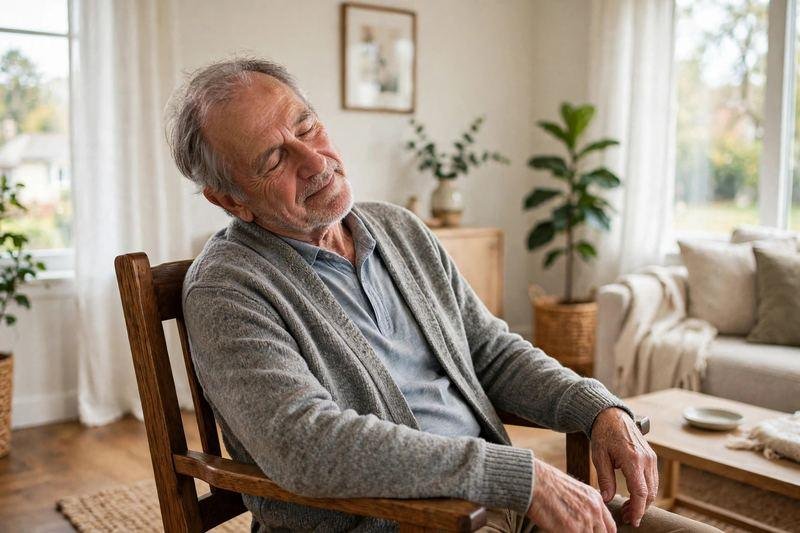
Sit tall in your chair. Drop your right ear toward your right shoulder until you feel a gentle pull on the left side of your neck. Do not yank your head down and do not roll your neck in circles — rolling can pinch nerves in older necks. Hold 30 seconds, breathing slowly. Repeat on the left. This is the pose to use at your desk or in the car (as a passenger) when tension creeps up.
2. Shoulder Rolls and Shrug Release — 10 Slow Rolls
Still seated, lift both shoulders up to your ears, hold for 3 seconds, then drop them all the way down with a long exhale. Do that 3 times. Then roll both shoulders backward in slow circles, 10 times. Stress parks itself in the trapezius muscles across the top of your shoulders, and most seniors carry them halfway to their ears without noticing. The shrug-and-drop resets them.
3. Seated Cat-Cow — 6 Slow Rounds
Sit on the front half of your chair, feet flat, hands on your knees. Breathe in and arch your back gently, lifting your chest and looking slightly up. Breathe out and round your back, tucking your chin and pulling your belly in. One inhale and one exhale is one round. Do 6 rounds, about 60 to 90 seconds total. Keep the movement small. If your lower back complains, make the arch smaller, not bigger.
4. Standing Forward Fold with Chair Support — 30 Seconds
Stand behind your chair and rest both hands on the chair back. Walk your feet back a small step and fold forward from your hips, keeping your back flat like a tabletop. Let your head hang loose and your neck relax. Hold 30 seconds, breathing into your belly. This gentle fold lets blood flow to the head and gives the lower back a break. Come up slowly — stand up over 5 seconds, not in one jerk, so you do not get dizzy.
5. Seated Spinal Twist — 30 Seconds Each Side
Sit sideways on your chair so your right side faces the chair back. Hold the chair back with both hands and twist gently toward it. Keep your spine tall — the twist comes from your middle back, not from yanking your neck around. Hold 30 seconds, breathing normally. Switch sides. Twists wring out the stiffness that builds up from sitting all day, and they feel best after the cat-cow above.
6. Standing Tree Pose with Chair — 20 Seconds Each Foot
Stand beside your chair, one hand resting lightly on the chair back. Shift your weight onto your left foot and place your right foot against your left ankle (not on your knee — the ankle is safer). Hold 20 seconds. Switch feet. Balance poses demand your full attention, and that is exactly why they calm a busy mind: you cannot worry about tomorrow’s appointment while you are focused on standing on one foot. If you wobble, that is normal. Put the foot down, reset, and try again.
7. Legs Up the Chair — 3 Minutes
This is the pose that does the most for stress, and it asks the least of you. Lie on your back on your mat or rug, scoot close to a chair, and rest your calves on the chair seat so your knees bend at about 90 degrees. Arms rest at your sides, palms up. Close your eyes. Breathe slowly — in for 4, out for 6 — for 3 full minutes. Elevating your legs like this slows your heart rate and lets the muscles in your lower back fully let go. If getting down to the floor is hard for you, do it on your bed instead. Same pose, same benefit.

The 20-Minute Sequence, Start to Finish
Put it together like this, and set a kitchen timer so you are not watching the clock:
- Belly breathing, seated — 2 minutes
- Seated neck release — 1 minute (30 seconds each side)
- Shoulder rolls and shrug release — 1 minute
- Seated cat-cow — 1 to 2 minutes
- Standing forward fold with chair — 30 seconds, then rest 30 seconds
- Seated spinal twist — 1 minute (30 seconds each side)
- Standing tree pose with chair — 1 minute (20 seconds each foot, plus resets)
- Legs up the chair — 3 minutes
- Quiet sitting, eyes closed, normal breathing — 2 minutes
That adds up to about 15 minutes of movement plus 5 minutes of breathing and rest. Do it in the evening if stress keeps you awake, or in the morning if you wake up tense. Either time works. The best time is the one you will actually keep.
How Often, and How to Start
For stress relief, short and regular beats long and rare, and that is the first rule of yoga for older adults: aim for 3 to 5 sessions a week, 20 minutes each. Many seniors notice they feel calmer right after the first session — shoulders lower, breathing slower, jaw unclenched. Deeper changes, like falling asleep faster and feeling less wound up during the day, usually show up after 2 to 4 weeks of steady practice.
If 20 minutes feels like a lot on day one, start with 10: the breathing, the neck release, the shoulder rolls, and legs up the chair. Add one pose every few days. There is no deadline. The routine works at 10 minutes too; it just works a little less. If you are completely new to yoga, our beginning yoga for seniors guide walks through the first week step by step, and the breathing exercises for seniors page teaches the belly breathing used here in more detail.
Keep a simple note on your fridge: the date, and one line about how you felt after. “Slept better.” “Shoulders loose.” After two weeks you will have your own proof, which beats any article telling you it works.
5 Mistakes That Make Stress Worse
1. Treating it like a workout. If you push, strain, or try to match a video of a 25-year-old, your body reads it as more stress, not less. Slow is the method. If you finish the routine sweating and out of breath, you went too hard.
2. Skipping the breathing. The poses without the slow breathing are just stretching. The breathing is what lowers cortisol, and it is the heart of yoga for older adults. If you only have 5 minutes, do 5 minutes of belly breathing and skip the poses entirely.
3. Practicing right after bad news. Give yourself 10 minutes after a stressful call or argument before you start. Sit, drink water, let the first wave pass. Yoga works better on a settling nervous system than on a spiking one.
4. Holding your breath in hard poses. Breath-holding raises blood pressure and tension. If you catch yourself holding your breath, that pose is too hard for today. Ease off.
5. Doing it once and quitting. One session helps for an evening. The real change comes from repetition. Put it on your calendar like a pill you take — same time, most days, no debate.
What You Need
Almost nothing. A sturdy chair without wheels, a mat or a thick rug, and loose clothes. That is the whole kit for yoga for older adults at home. A folded blanket under your head for legs up the chair is nice but optional. A kitchen timer helps. Total cost if you own nothing: a basic yoga mat runs about $15 to $25, and a chair you already have works fine. Skip the expensive props, the special clothes, and the apps that charge a monthly fee. None of them lower stress faster than the breathing above.
When Yoga Is Not Enough
Yoga helps with everyday stress. It does not replace professional help. If stress leaves you unable to sleep most nights, if you feel hopeless or panicky for weeks at a time, or if worry is stopping you from eating, leaving the house, or enjoying anything, talk to your doctor. There is no shame in that, and it is the strongest move you can make. The US National Center for Complementary and Integrative Health notes that yoga can help with stress and sleep, and it also lists the conditions where extra care is needed — read that page before you start if you have any health condition at all.
Frequently Asked Questions
How long does yoga for older adults take to reduce stress?
Many people feel calmer within minutes of finishing a session — slower breathing, looser shoulders, a quieter mind. Research on cortisol suggests measurable changes build over about 10 days of regular practice. For lasting change, give it 2 to 4 weeks of 3 to 5 short sessions a week before you judge it.
Can seniors do yoga for stress relief every day?
Yes. Gentle yoga is safe to do daily for most seniors, as long as you keep it slow and skip anything that hurts. A 10-minute daily routine of breathing and two or three gentle poses often works better than one long session a week. Take a rest day if you feel sore or tired.
What type of yoga for older adults is best for stress relief?
Slow, gentle styles: restorative yoga, gentle hatha, and chair yoga. Avoid hot yoga, power yoga, and fast flows — the heat and speed raise your heart rate and can leave you more wired, not less. If a class or video moves faster than your breathing, it is the wrong class for stress relief.
Does yoga really lower cortisol?
A 2025 analysis of 44 trials found yoga lowered cortisol more than other forms of exercise studied, and the effect came mostly from slow breathing and relaxation rather than from hard physical effort. That does not mean yoga fixes every stress problem, but it does mean the breathing part of the practice is doing real work, not just feeling nice.
Can I do yoga for older adults if I cannot get on the floor?
Yes. Every pose in this routine except legs up the chair is done seated or standing with a chair, and legs up the chair works just as well on a bed. If you use a wheelchair or cannot stand safely, do the seated poses only — the breathing and the neck, shoulder, and twist work still deliver most of the calm.
Learn who writes these guides and why, send us a message through our contact page, read our full disclaimer, and see how we handle your information.