

Stretching Exercises for Seniors: A Gentle 15-Minute Routine for Flexibility and Balance
If your shoulders feel tight when you reach for a shelf, your hips ache after sitting, or your calves complain on the stairs, stretching exercises for seniors can help — and they take less time than making a cup of tea. This routine takes 15 minutes, needs only a sturdy chair and a wall, and asks for no equipment, no floor work, and no flexibility to start with.
Stretching is not yoga. There are no poses to learn and no breathing patterns to memorise. Each stretch is one simple movement, held still for 15 to 30 seconds, then released. You do them in your own home, in your everyday clothes, at whatever pace suits you. If you can sit in a chair and stand behind it, you can do this routine today.
What Stretching Does for You After 65
After 65, muscles lose elasticity a little each year, and joints stiffen when they are not moved through their full range. That is why reaching overhead gets harder, why your neck turns less far when you reverse the car, and why the first steps in the morning feel wooden. Gentle stretching works directly on that stiffness: it lengthens the muscles, keeps the joints moving, and warms the tissues before you walk, garden, or climb stairs.
The benefits are practical, not abstract. Flexible ankles and calves make each step steadier, which lowers the chance of a trip. Looser hips make it easier to get in and out of a car. A mobile neck makes driving safer. And a few minutes of slow stretching in the morning can take the edge off the stiffness that builds overnight — most people feel the difference in the first week, not the first month.
Stretching is not a cure for arthritis, back pain, or any medical condition, and it will not replace strength training or balance practice. But it is the easiest piece of the puzzle to start, and it makes the other pieces — walking, chair yoga, balance work — easier to do. The National Institute on Aging lists flexibility as one of the four types of exercise older adults need, alongside endurance, strength, and balance.
What You Need
- A sturdy chair without wheels. A wooden dining chair is ideal. The chair is your support for the seated stretches and your balance aid for the standing ones.
- A clear wall. Two stretches use the wall. Clear a space about an arm’s length wide, with nothing on the floor to trip over.
- A non-slip surface. A rug with a non-slip pad, or bare floor in socks with grip. Do not stretch on a polished floor in smooth socks.
- Comfortable clothes you can move in. Loose trousers and a top you can raise your arms in are enough. No special clothes.
- A folded towel. Roll it up and use it as a grip aid if you cannot reach your foot or shin in the hamstring stretch.
That is everything. No mat, no bands, no straps. If you own a yoga strap or a belt, it can help in one stretch below, but it is not required.
Safety First
Check with your doctor before starting, especially if you have osteoporosis, a recent joint replacement, a heart condition, high or low blood pressure, or balance problems. This article is educational only, not medical advice.
Stop and rest if you feel sharp or pinching pain, dizziness, nausea, breathlessness, or numbness or tingling. A stretch should feel like gentle tension — a mild pull you can breathe through. Pain is a stop sign, not a challenge. Rise slowly from every seated stretch; standing up fast can drop your blood pressure and make you lightheaded. Never hold your breath during a stretch — if you catch yourself holding it, you are pushing too hard. If you have glaucoma or eye-pressure problems, skip any stretch that puts your head below your heart.
The 15-Minute Stretching Routine
Do the stretches in order. The first three loosen the neck, shoulders, and chest — the areas that stiffen most from sitting. The middle three work the spine, hips, and hamstrings. The last two wake up the calves and ankles, which carry you through every step. Hold each stretch for the time given, breathing slowly the whole way. Never bounce.
1. Neck Side Stretch (1 minute)
Sit tall in your chair, feet flat on the floor, hands resting on your thighs. Let your right ear drop slowly toward your right shoulder until you feel a gentle pull along the left side of your neck. Hold for 20 seconds, breathing normally, then come back to center and repeat on the other side. Do each side twice. Keep your shoulders down and relaxed — if your shoulder creeps up toward your ear, lower it before you start the stretch. This is the best first stretch of the day, because the neck is where overnight stiffness settles first.
2. Cross-Body Shoulder Stretch (1 minute)
Sit tall and bring your right arm straight across your chest. Use your left hand to press the right arm gently toward your chest — just above the elbow, never on the elbow joint itself. Hold for 20 seconds, then switch arms. Do each side twice. If your shoulder will not reach across, bring the arm as far as it goes and hold there; the stretch works at whatever range you have today, and the range grows over weeks. This stretch targets the back of the shoulder, which tightens from reaching forward at a desk, a sink, or a steering wheel.
3. Chest Opener at the Wall (2 minutes)
Stand facing a wall, about an arm’s length away. Place your right palm flat on the wall at shoulder height, fingers pointing back behind you. Turn your body slowly away from the wall until you feel a stretch across the front of your chest and shoulder. Hold for 20 seconds, then switch sides. Do each side twice. Keep your hand on the wall the whole time and turn only as far as the stretch stays gentle. Rounded shoulders from years of sitting pull the chest muscles short; this is the stretch that opens them back up, and it is the one most people skip — do not.
4. Seated Spinal Twist (2 minutes)
Sit tall in your chair, feet flat, knees pointing forward. Place your right hand on the outside of your left knee and your left hand on the chair back behind you. Turn your chest gently to the left, looking over your left shoulder as far as is comfortable. Hold for 20 seconds, breathing slowly, then return to center and repeat on the other side. Do each side twice. Turn from the waist and chest, not by forcing your neck — your head follows your chest, it does not lead the twist. This keeps the spine mobile for turning to look behind you, which matters every time you reverse a car.
5. Seated Hamstring Stretch (2 minutes)
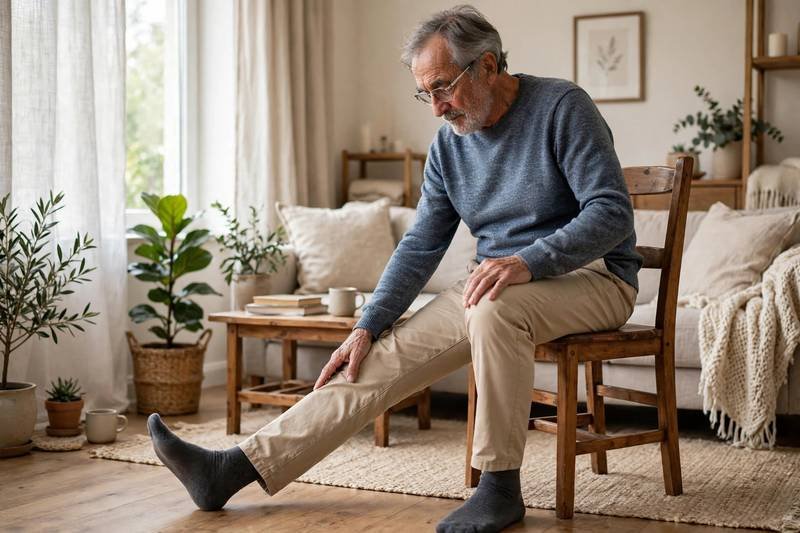
Sit on the front half of your chair, feet flat. Straighten your right leg out in front of you, heel on the floor, toes pointing up. Sit tall, then lean forward gently from your hips — not by rounding your back — until you feel a pull down the back of your thigh. Hold for 30 seconds, then switch legs. Do each leg twice. If you cannot reach your shin, loop the rolled towel around your foot and hold the ends. Tight hamstrings pull on the lower back and shorten your stride; 30 seconds per leg, twice a day, is the dose that actually changes them.
6. Standing Calf Stretch at the Wall (2 minutes)
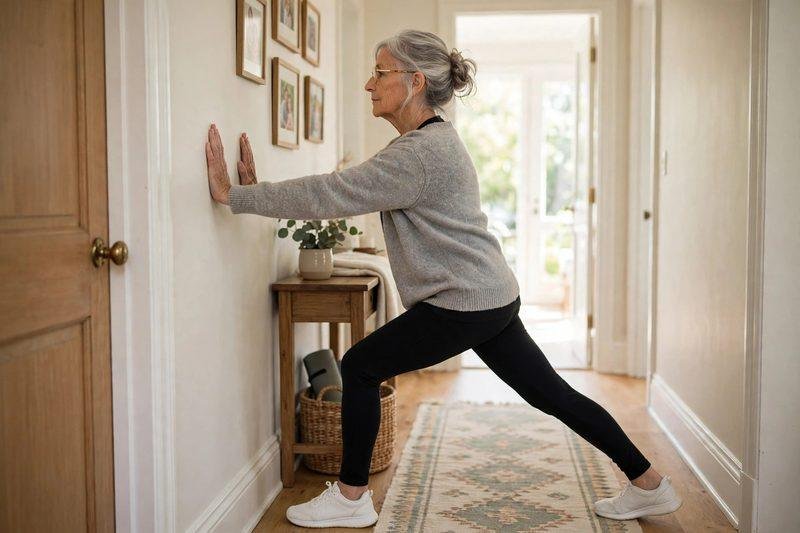
Face the wall, hands flat on it at shoulder height, about an arm’s length away. Step your right foot back about 2 feet, keeping the heel pressed flat on the floor and the knee straight. Lean into the wall until you feel a stretch in the back of your right calf. Hold for 30 seconds, then switch legs. Do each leg twice. If your back heel lifts, step the foot closer — a shorter stance with the heel down beats a long stance with a lifted heel. Stiff calves are the most common cause of the shuffling, short steps that lead to trips, so give this stretch the full 30 seconds.
7. Seated Figure-Four Hip Stretch (2 minutes)
Sit tall in your chair, feet flat. Lift your right ankle and rest it on your left knee, letting the right knee fall gently out to the side. Sit tall and lean forward slightly from your hips until you feel a stretch deep in your right hip and buttock. Hold for 20 seconds, then switch sides. Do each side twice. If the ankle will not reach the knee, rest it on the shin instead — the stretch still works. This is the stretch for the hip stiffness that makes getting out of a low chair or a car seat hard.
8. Ankle Circles and Calf Raises (3 minutes)
Sit tall, feet flat. Lift your right foot a few inches off the floor and draw slow circles with your ankle — 10 circles one way, 10 the other. Switch feet. Then stand behind your chair, one hand resting lightly on the back, and rise slowly onto your toes, hold for 2 seconds, and lower back down. Do 10 slow raises. Keep your hand on the chair the whole time. Ankle mobility is the piece of flexibility most routines leave out, and it is the piece that keeps your steps steady on uneven ground. Finish by sitting quietly for a minute, breathing slowly — do not skip the rest, it is when your muscles absorb the work.
Stretches to Skip for Now
Not every stretch is safe to start with. Leave these out until your doctor or a qualified teacher says otherwise:
- Deep standing toe touches. Bending far forward with straight legs strains the lower back and can make you dizzy when you come up. The seated hamstring stretch above does the same job safely.
- Overhead stretches with weights. Holding a weight overhead while stretching loads the shoulder joint. Stretch the shoulders with body weight only.
- Neck circles. Rolling the head in full circles can pinch nerves and strain the small neck joints. The side stretch above is the safer way to loosen the neck.
- Stretches on a soft bed or sofa. A soft surface gives no support and lets your body sink into poor positions. Use the firm chair and the wall.
- Any stretch that needs a partner to push you. A partner cannot feel how far is too far. Stretch only to the point you control yourself.
Common Mistakes and How to Fix Them
- Bouncing into a stretch. Bouncing tears cold muscle. Move into each stretch slowly and hold still. If you feel the urge to bounce, you are pushing too far.
- Holding your breath. Beginners hold their breath without noticing, usually on the hardest stretch. If you catch yourself doing it, come out of the stretch, take two slow breaths, and start again.
- Stretching cold muscles first thing. Do the routine after a short warm-up — a 5-minute walk around the house, or the seated breathing from our guide on breathing exercises for seniors. Cold muscles tear more easily than warm ones.
- Forcing the range. Your range today is your range today. Forcing a stretch past gentle tension does not speed up flexibility; it causes the muscle to tighten up to protect itself, which is the opposite of what you want.
- Skipping one side. Stretch both sides every time, even if one side feels fine. Uneven flexibility pulls the body out of line and shows up as a limp or a sore hip.
- Doing too much on day one. Fifteen minutes is the whole routine. Do not add extra stretches because it felt easy — soreness shows up the next day, and a sore first-timer often quits.
Your First 4 Weeks
- Week 1: 3 sessions, 15 minutes each, every stretch once per side. Expect mild muscle soreness for a day or two after the first session — that is normal.
- Week 2: 3 to 4 sessions. Add a second round of the calf stretch and the hamstring stretch — the two that change walking most. Notice which side is tighter and give it the extra 10 seconds.
- Week 3: 4 sessions, 15 minutes. Try the standing stretches with just fingertips on the chair instead of a full hand — but keep the chair there.
- Week 4: 4 to 5 sessions. If the routine feels easy all the way through, add the standing stretches from our guide on yoga poses for seniors, one at a time.
Fifteen minutes three times a week beats one long session a month. Short and regular is how the habit forms, and the habit is what changes your flexibility over months. If you miss a day, just do the next session — there is no catching up, and no penalty for a missed day.
How Often Should Seniors Do Stretching Exercises?
For stretching exercises for seniors, three to five times a week is the sweet spot. Daily is fine too if you keep it to 10 or 15 minutes and never push into pain. What matters most is regularity: the same short routine, the same time of day, most days of the week. Morning works best for most people, because it clears the overnight stiffness before the day starts — but the best time is the time you will actually do. Pair the routine with a daily walk and you cover the two things that protect independence best — flexible joints and steady legs. If you already do chair yoga, this routine slots in on the days between — the two work well together, because chair yoga builds strength from the same seated position.
Frequently Asked Questions
How often should seniors do stretching exercises?
Three to five times a week, 10 to 15 minutes at a time. Fifteen minutes three times a week beats one long session a month, because the benefit comes from doing it regularly, not from doing a lot at once. If you miss a day, just do the next session — there is no catching up.
How long should I hold each stretch?
Hold each stretch for 15 to 30 seconds, breathing slowly the whole time. The neck and shoulder stretches in this routine use 20 seconds; the hamstrings and calves use 30 seconds because those are bigger, tighter muscles. Holding longer than 30 seconds adds little, and holding less than 15 seconds does not give the muscle time to release. Never bounce — a bounced stretch is a pulled muscle waiting to happen.
Is stretching safe if I have arthritis?
For most people with arthritis, gentle stretching is safe and helps — it keeps the joints moving and eases the stiffness that builds when a joint sits still. The rules are stricter, though: stretch only to gentle tension, never to pain, and never force a swollen or hot joint. Warm the joint first with a few minutes of gentle movement or a warm towel. Check with your doctor before starting, and stop any stretch that makes a joint hurt more the next day.
Can stretching improve my balance?
It helps, but it is not a replacement for balance practice. Flexible ankles and calves let your feet adjust on uneven ground, and looser hips let you recover when you wobble — both of those make a trip less likely. But balance itself is a skill that needs practice, so pair this routine with the balance work in our guide on balance yoga for seniors, which trains the steadiness directly.
Do I need any equipment to stretch at home?
No. This whole routine needs only a sturdy chair and a clear wall — no mat, no bands, no straps. A rolled towel helps in the hamstring stretch if you cannot reach your foot, and a belt or strap can do the same job, but neither is required. If you later want more options, the stretches in our guide on morning stretches for seniors use the same chair-and-wall setup.
If you found these stretching exercises for seniors doable, try our guide on chair yoga for seniors next — it builds on the same seated position with a few more options — or read our guide on beginning yoga for seniors for a fuller starting plan. For the breathing side of practice, see our guide on breathing exercises for seniors. And if this guide helped, you can learn who writes these guides and why on our about page, or send us a message through our contact page if a step did not work the way we described it. Before you start any exercise, read our full disclaimer, and see how we handle your information on our privacy page.