

Restorative yoga for seniors is the slowest kind of yoga there is — and that is the whole point. You do not stretch hard, hold a balance, or work up a sweat. You lie back on pillows, breathe slowly, and let the props hold your weight for three to five minutes at a time. Twenty minutes of it leaves stiff joints looser, shoulders lower, and the mind quieter than when you started.
This guide is for anyone over 60 who wants the calm and flexibility of yoga without getting down on the floor for a class or holding a pose until their legs shake. Everything here uses things you already own: firm pillows, folded blankets, a belt or scarf, and a wall. No mat, no blocks, no special clothes, and no money spent.
What Restorative Yoga for Seniors Really Is
Restorative yoga is different from the gentle yoga most guides describe. In a regular gentle class you move through poses, even slowly. In restorative yoga for seniors you get into one comfortable position, settle in, and stay still. The props do the work. Your muscles switch off because nothing is being held up by effort — the pillow under your knees, the blanket under your back, the wall under your legs.
A review of 22 studies on yoga in later life, from the University of Edinburgh, found that older adults who practised yoga had better balance, flexibility, leg strength, sleep quality, and mood than people who did no activity. Restorative yoga is the gentlest end of that same practice — it will not build strength the way standing poses do, and no honest guide should promise that. What it does well is loosen stiff joints, calm the nervous system, and help you sleep.
Restorative Yoga vs. Yin Yoga — Do Not Mix Them Up
People often confuse the two, and the difference matters for safety. Yin yoga holds deep stretches for several minutes — it asks for a real stretch, and it can be too much for stiff or painful joints. Restorative yoga asks for no stretch at all. You should feel supported and comfortable within ten seconds of settling in. If a position pulls or aches, add another pillow or skip it. Comfort is the test, not effort.
What Restorative Yoga for Seniors Can Do for You
- Loosens stiff joints gently. Long, supported holds let the muscles around the hips, shoulders, and spine relax instead of guarding.
- Eases the ache of a long day. Sitting for hours tightens the lower back and hips. Two supported poses in the evening undo much of that.
- Helps you sleep. Slow breathing and stillness lower your heart rate and tell the body the day is over.
- Calms worry without any effort. You do not have to clear your mind. Lying still and breathing slowly does the calming on its own.
- Fits a body that cannot do floor work. Every pose below has a bed or chair version.
What You Need — From Your Own Home
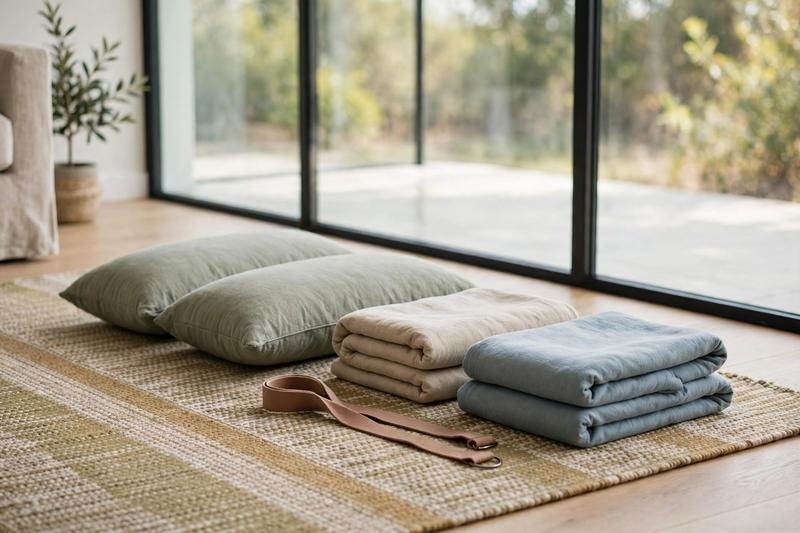
You need no yoga equipment at all for restorative yoga for seniors — just things you already own. Gather two firm pillows (one for under your knees, one for under your head or chest), two folded blankets or large towels, a belt or scarf, a clear wall for the legs-up-the-wall pose, a chair as a backup, a timer on your phone, and warm socks with a light blanket, because your body cools down when you lie still. Set everything out before you begin: getting up halfway through to fetch a pillow breaks the calm you are building.
Safety First
Read these rules before the first session of restorative yoga for seniors.
- Talk to your doctor first — especially if you have osteoporosis, a recent joint replacement, a heart condition, low blood pressure, glaucoma, or a recent injury or surgery.
- If you have osteoporosis, skip deep forward folds and deep twists. Bending the spine forward under load is the one move that can cause a fracture in thin bones. Every pose below keeps the spine long and supported — never fold forward.
- Do not do legs-up-the-wall if you have glaucoma, uncontrolled high blood pressure, or a heart condition without asking your doctor first.
- Never force a position. Pain, pinching, numbness, or tingling means stop and adjust. Restorative yoga should feel like lying on a comfortable bed.
- Get up slowly. After lying still for twenty minutes, your blood pressure is low. Roll to your side, sit up, wait thirty seconds, then stand with a hand on the chair.
This article is educational only. It is not medical advice, and it does not replace your doctor. Talk with a healthcare professional before starting, and stop if you feel sharp pain, dizziness, or chest discomfort.
The 20-Minute Restorative Yoga for Seniors Routine
Do these five poses in order, once a day, in the late afternoon or an hour before bed. Each pose has a hold time — set the timer and let it run. Breathe in through your nose for a slow count of four, out through your mouth for a slow count of six. If your mind wanders, bring it back to the breath. That is the whole job. If the floor is not an option, do this restorative yoga for seniors routine on your bed — or seated in a chair, with the reclining pose done sitting back on pillows and legs-up-the-wall done with your feet on a footstool.
1. Supported Reclining Pose — 5 Minutes
Lie on your back on the floor or on your bed. Put a firm pillow under your knees so they bend slightly, and a folded blanket under your head. Let your arms rest at your sides, palms up. Close your eyes. This is the warm-up pose: it tells your back and hips they can let go. If your lower back aches, slide a second pillow under your knees until the ache fades. Hold five minutes.
Chair version: sit in a sturdy chair, feet flat on the floor, a pillow behind your lower back and one under each forearm on the armrests. Close your eyes and breathe for five minutes.
2. Legs Up the Wall — 4 Minutes
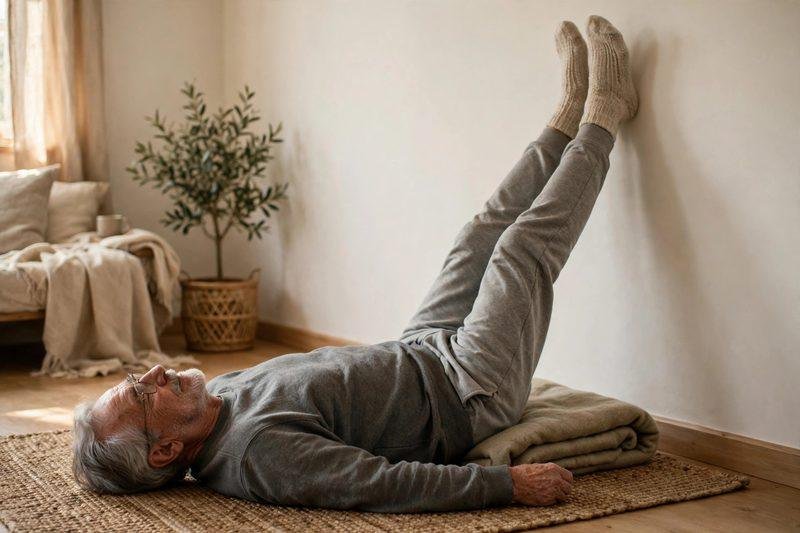
Sit sideways next to a clear wall, then swing your legs up so your heels rest on the wall and your bottom is close to it. Put a folded blanket under your hips if your lower back feels tight. Your legs can be straight or slightly bent — bent is fine and easier on the knees. Rest your arms at your sides, palms up. This pose drains the heavy feeling out of tired legs and slows your heart rate more than any other pose here. Hold four minutes. Come out slowly: bend your knees, roll to your side, and sit up before standing.
3. Supported Bridge — 3 Minutes
Lie on your back with your knees bent and feet flat on the floor, hip-width apart. Lift your hips a few inches — just enough to slide a folded blanket under your lower back, at the level of your belt line. Lower your weight onto the blanket and let your legs stretch out straight, one at a time. Your hips should feel lifted and your belly open, with no effort at all. If you feel a pinch in your lower back, the blanket is too high — use a thinner fold. Hold three minutes.
4. Reclined Bound Angle — 4 Minutes
Lie on your back with a pillow under your head and a folded blanket under your spine, running from your shoulder blades to your hips, so your chest opens gently. Bring the soles of your feet together and let your knees fall out to the sides. Put a pillow under each knee so they are fully supported — the knees should rest on the pillows, not hang in the air. If the stretch in the inner thighs is too strong, move your feet further from your body. Hold four minutes, breathing slowly. This is the pose most people fall asleep in, and that is fine.
5. Final Rest — 4 Minutes
Lie flat on your back, legs straight, arms at your sides, palms up. No pillow under the knees this time — just lie still. Cover yourself with the light blanket. Let your breathing slow down on its own. Do not try to relax; just lie there and let the weight of your body sink into the floor. Hold four minutes, then roll to your side and sit up slowly.
How Often, and How to Start
Three times a week is enough to feel the difference in your joints and your sleep. Daily is better if you enjoy it, and the evening is the best time — an hour before bed, when the day is done. Three sessions of restorative yoga for seniors a week, kept up for a month, will tell you more than any single session can.
Week one: do poses one and five only, nine minutes, three times a week. Add the legs-up-the-wall pose in week two, and the bridge and bound angle in week three. If a pose does not suit you, drop it and keep the rest — four poses done well beat five done badly. Keep a short note after each session: the date, how long you held each pose, and how you slept that night. After two weeks you will see the pattern.
Common Mistakes — and What Happens When You Make Them
The most common mistakes in restorative yoga for seniors are small ones, and each has a clear fix.
- Holding a stretch that hurts. Restorative yoga should never hurt. Pain means a prop is missing or the pose is wrong for you. Add a pillow, change the angle, or skip the pose.
- Skipping the props. Lying flat on a hard floor with no support is not restorative — it is just lying on a hard floor. The pillows are the method, not a luxury.
- Rushing the hold times. Two minutes in a pose is not enough for the muscles to switch off. Set the timer for the full time and stay put.
- Getting up fast at the end. Standing up quickly after twenty minutes lying still can make you light-headed. Roll to your side, sit, wait thirty seconds, then stand with a hand on something solid.
- Treating it as a workout. If you finish the session feeling worked, you did it wrong. You should finish feeling heavy, warm, and sleepy.
Troubleshooting
Three problems come up most often when people start restorative yoga for seniors. Each has a simple fix.
“I cannot get down to the floor or back up again.” Do the whole routine on your bed, or seated in a chair as described at the start of the routine. The floor adds nothing — the props and the stillness are what matter. Our chair yoga for seniors is also built for people who stay seated.
“My knees hurt in the reclined bound angle pose.” Your knees are hanging in the air. Put a pillow under each knee until they rest on something, and move your feet further from your body. If it still hurts, skip the pose and do an extra two minutes of the supported reclining pose instead.
“I fall asleep every time.” That is a good sign, not a problem. Your body is telling you it needed the rest. Set a gentle alarm so you do not sleep on a hard floor for an hour — a cold floor and a stiff neck undo the benefit. A short bedtime yoga routine pairs well with this one if sleep is your main goal.
When to Call the Doctor
Restorative yoga for seniors is gentle, but it is not a treatment for any condition. Call your doctor if you notice new or worsening back pain that lasts more than a few days, numbness or tingling in your legs, swelling in your ankles that does not go away overnight, dizziness when you stand up, or chest discomfort during or after a session. Also call if your sleep does not improve after three weeks of regular practice — poor sleep can have causes a routine cannot fix, and it is worth checking.
Read about who writes these guides and why, or send us a message through our contact page. You can also read our full disclaimer and how we handle your information.
Frequently Asked Questions
Is restorative yoga for seniors safe?
Yes, when it is done with props, without forcing any position, and with your doctor’s approval first — especially if you have osteoporosis, a recent joint replacement, low blood pressure, or glaucoma. Every pose should feel comfortable within ten seconds. Pain, pinching, or numbness means stop and adjust. People with osteoporosis should skip deep forward folds and deep twists entirely, and people with glaucoma or uncontrolled high blood pressure should ask their doctor before doing legs-up-the-wall.
How long should you hold each restorative yoga pose?
Three to five minutes per pose is the right range for seniors. Shorter holds do not give the muscles time to switch off, and longer holds can leave you stiff and cold. This routine uses five minutes for the opening pose, four minutes each for legs-up-the-wall and reclined bound angle, and three to four minutes for the bridge and final rest. Set a timer so you are not guessing.
Do I need to buy props or equipment for restorative yoga?
No. Firm pillows, folded blankets, a belt or scarf, and a clear wall are all you need, and most people already own them. Yoga bolsters and blocks exist, but a rolled blanket does the same job. Do not spend money before you know you like the practice — try it with household items for two weeks first.
Can restorative yoga for seniors help me sleep better?
It can help, and sleep is one of the best-studied benefits of yoga in later life — the University of Edinburgh review of 22 studies found improved sleep quality in older adults who practised yoga regularly. A short session an hour before bed, with slow breathing and no screens after, works better than a long session at midday. It will not cure long-term insomnia on its own, so if you sleep badly most nights for weeks, talk to your doctor.
What is the difference between restorative yoga and regular yoga?
Regular yoga moves through poses and asks your muscles to work — standing, balancing, stretching. Restorative yoga for seniors asks for no effort at all: you settle into one supported position and stay still for three to five minutes while the props hold your weight. It will not build strength the way standing poses do, but it loosens stiff joints and calms the nervous system better than any active class. Many people do both — an active routine in the morning and a restorative one before bed. For more movement of your own, our gentle morning stretches for seniors start the day the same way, and our gentle balance practice for seniors and calm 10-minute routine for worry pair well with this routine.