

Introduction
If you lie awake at night, or you wake at 3 a.m. and cannot drift off again, you are not alone. After 60, sleep often gets lighter and shorter.
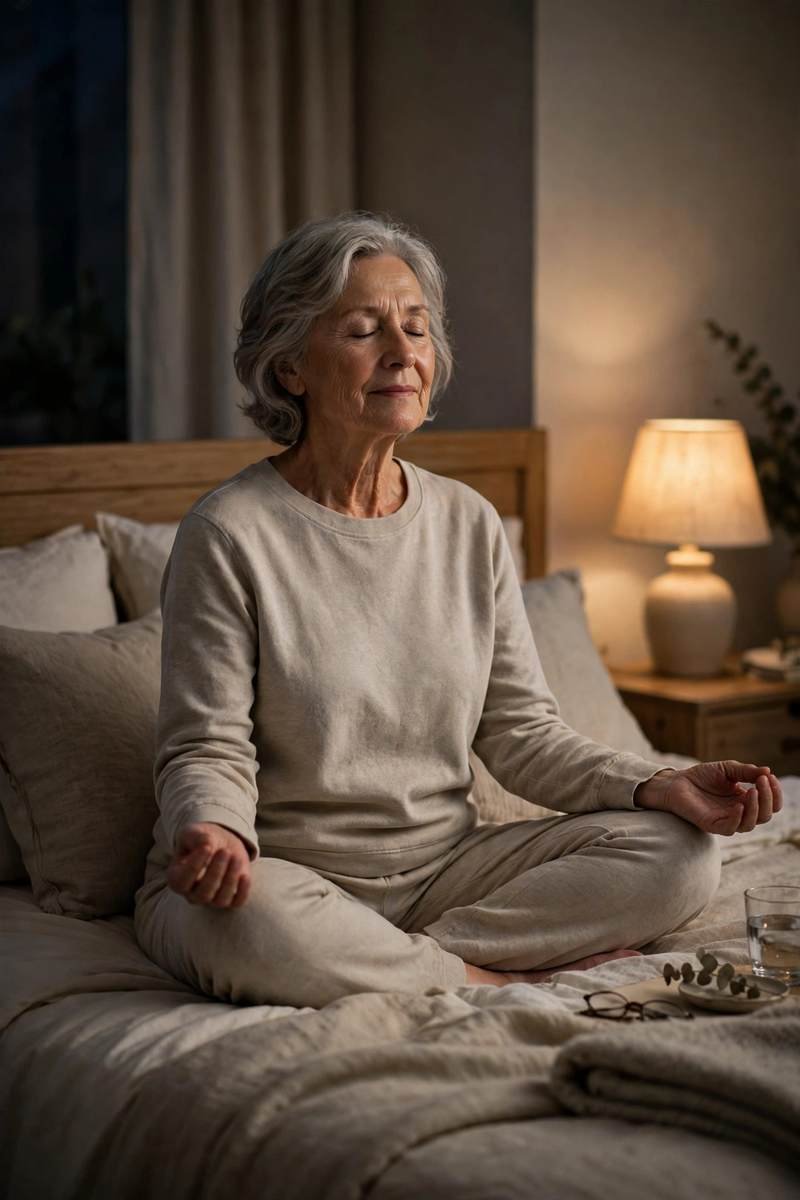
Bedtime yoga for seniors is a quiet, practical way to help your body and mind slow down before sleep. This guide gives you a gentle 20-minute routine you can do on a mat or right in bed — no standing, no kneeling, and nothing that asks you to push through pain.
Why Sleep Gets Harder After 60
Sleep changes with age. First, sleep becomes lighter — older adults spend less time in deep sleep and wake more easily. Second, the body’s sleep clock shifts earlier, so many seniors feel sleepy by 9 p.m. and wake at 4 or 5 a.m. Third, aches get in the way: hip pain, back pain, restless legs, and a stiff neck make it harder to settle. Fourth, the mind stays busy — worries about health, money, or family show up the moment the house goes quiet.
What Bedtime Yoga Can Do for Your Sleep
A short nightly practice can help in several real ways:
- Fall asleep faster. Slow breathing and gentle stretches lower your heart rate.
- Stay asleep longer. Relaxed muscles mean fewer wake-ups from stiffness.
- Ease stiff hips, a sore lower back, and restless legs.
- Quiet a racing mind. Counting your breath gives your thoughts something steady to follow.
- Build a sleep signal. Done at the same time each night, your body learns to expect sleep.
It will not cure insomnia, but for many seniors it turns a restless hour into a calm twenty minutes — and that is often enough to tip the night toward sleep.
Who Can Do This Routine
This routine is for adults over 60 who can lie down and get up from a bed or a mat without help — including people who take a long time to fall asleep, wake during the night, or feel stiff and restless in the evening. If getting down to the floor is hard, do the whole routine in bed.
Safety First: Read This Before You Begin
Read these points before your first session:
- Talk to your healthcare professional first if you have severe osteoporosis, a recent hip or knee replacement, spinal stenosis, or glaucoma.
- Stop at once if you feel sharp pain, dizziness, chest discomfort, or shortness of breath. Mild stretching is fine; sharp pain is not.
- Never force a stretch. Move only as far as feels comfortable.
- Do not do legs up the wall if you have glaucoma, uncontrolled high blood pressure, or recent eye surgery. Skip that pose.
- Keep a low light on until you are settled.
When to Practise: The Right Time of Evening
Finish your routine 30 to 45 minutes before lights-out. That gap lets your body cool down and your breathing settle while the calm feeling is still fresh. If your bedtime is 10:30 p.m., start at 9:45 p.m. and finish by 10:05 p.m., then get ready for bed with no phone and no bright screens. Do not do this routine right after a big evening meal; wait at least an hour.
Before You Begin: Set Up Your Room
Set the room to around 65 to 68 degrees Fahrenheit (18 to 20 degrees Celsius). A warm room keeps you awake; a cool room helps your body temperature drop. Dim the lights and turn the television off — bright overhead lights tell your brain it is still daytime. Put your phone on silent and leave it face down across the room. Lay out a firm pillow for your head, a second pillow for under your knees, and a light blanket. Wear loose night clothes.
The 20-Minute Routine
Move at your own pace. Every pose is done lying down.
Minutes 1 to 3: Slow Breathing in Bed
Lie on your back with a pillow under your head and a rolled blanket under your knees. Breathe in for a count of four, and out for a count of six. Repeat for six slow breaths.
Minutes 4 to 6: Knees to Chest — For a Stiff Lower Back
Draw both knees up toward your chest and hold them gently. Hold for three slow breaths. If both knees together feels too much, draw up one knee at a time. If you have had a hip replacement, keep the movement small — never force the hip past 90 degrees.
Minutes 7 to 9: Reclined Butterfly — For Tight Hips
Let your feet come down to the bed, soles together, knees falling open. Put a pillow under each knee if your hips feel tight. Breathe slowly for three minutes. If your knees sit high, add a second pillow under each knee. If you have had a hip replacement, keep your knees closer together.

Minutes 10 to 12: Supine Spinal Twist — For a Stiff Back and Restless Legs
Lie on your back with knees bent and feet flat on the bed. Drop both knees gently to the right, keeping your shoulders flat. Hold for three slow breaths, then drop them to the left for three breaths. This twist helps restless legs in the evening, and the crawling feeling often eases after a few nights. Keep the twist small.
Minutes 13 to 16: Legs Up the Wall — For Swollen Ankles and Tired Legs
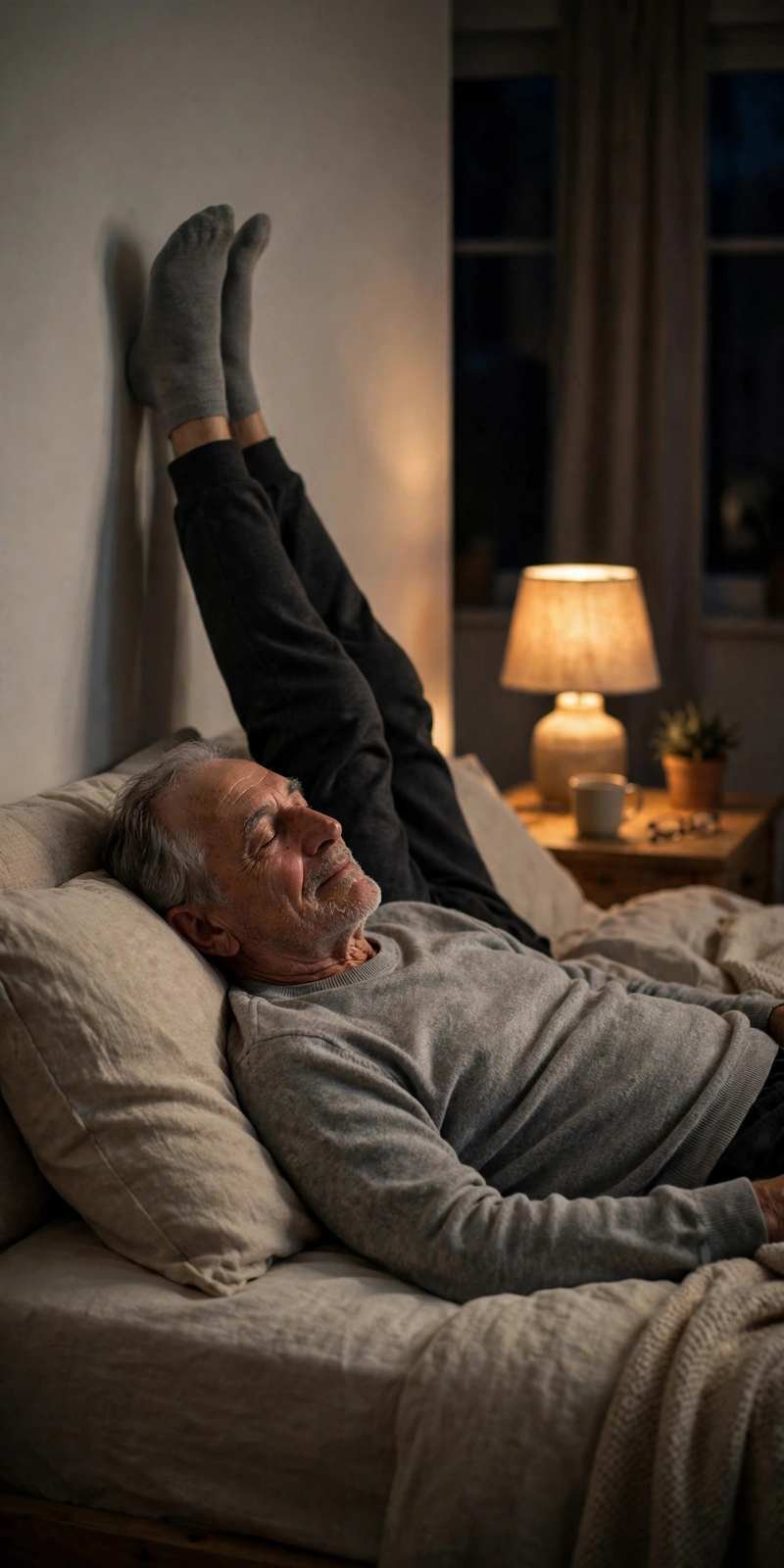
Scoot your hips close to the wall and swing your legs up, forming an L-shape. If the wall is too far, rest your calves on a stack of pillows instead. Stay here for three to four minutes, breathing slowly. This pose helps fluid that has pooled in your lower legs drain back, which is why it helps swollen ankles and tired legs. Skip it if you have glaucoma, uncontrolled high blood pressure, or recent eye surgery.
Minutes 17 to 20: Savasana — The Final Rest
Lie flat on your back, arms at your sides, palms up. Pull the light blanket over you and close your eyes. Breathe in for four counts, out for six. Do not try to fall asleep during savasana — just rest. If you are still awake after ten minutes, do not check the time. Just keep breathing slowly.
Can You Do Bedtime Yoga Right in Bed?
Yes — for most seniors, in bed is the best place to do it. Every pose here was written for a bed, so when the routine ends, you are already where you need to be. Two things to watch: a very soft mattress makes twists harder to control, so put a folded blanket under your hips; and getting into and out of bed in the dark is a fall risk, so keep a low light on. Skip the standing forward bend some pages suggest — in a dark bedroom, with sleepy legs, it is a fall risk.
What to Do If You Wake Up at 3 A.M.
Waking in the middle of the night is the most common sleep complaint after 60. Stay in bed and breathe first: in for four counts, out for six, for two minutes. Do not look at the clock. If your legs feel restless, do the supine spinal twist once on each side, then knees to chest for three breaths. If you are still wide awake after 20 minutes, get up and sit in a dim light in another room until you feel sleepy again. Then go back to bed and breathe slowly again. Do not do the full routine in the middle of the night — a short breathing reset is enough.
Common Mistakes to Avoid
- Checking your phone after the routine. One look at the news can undo twenty minutes of calm. Leave the phone across the room.
- Doing energetic yoga before bed. Fast flows and backbends raise your heart rate and wake you up. Bedtime is for slow, gentle poses only.
- Forcing a pose. If it pinches or hurts, make it smaller. Pain wakes the body up; a mild stretch settles it down.
- Holding your breath. If you catch yourself holding your breath, ease off. Breathing keeps muscles relaxed; holding it makes them tighten.
How Often Should You Practise?
Practise every night, at the same time, for at least two weeks before you judge it. Ten calm minutes every night will do more than one long session a week. Most people feel calmer at bedtime within three or four nights. Falling asleep faster and waking less often usually takes two to three weeks. If you miss a night, do not double the routine the next night — just pick it up again at the usual time.
Troubleshooting: When It Does Not Seem to Work
Your mind keeps racing. Try the 4-7-8 breathing in bed after the routine: in for four counts, hold for seven, out for eight. Do four rounds, no more.
Your legs feel restless every night. Do the supine spinal twist and legs up the wall every night, not just when the feeling is bad. If the crawling feeling is strong most nights, talk to your healthcare professional.
You feel more awake after the routine, not less. Slow every movement down by half, make every stretch smaller, and spend an extra two minutes on the slow breathing at the start.
When to See a Healthcare Professional
This is a gentle daily habit, not a substitute for medical care. See a healthcare professional promptly if you notice loud snoring with pauses in breathing; you fall asleep during the day without meaning to; leg pain or restlessness most nights that does not ease with stretching; sleep problems that started after a new medicine; or poor sleep that keeps getting worse over a month despite a regular bedtime routine.
Frequently Asked Questions
How long before bed should seniors do bedtime yoga?
Finish your routine 30 to 45 minutes before lights-out. If your bedtime is 10:30 p.m., start at 9:45 p.m. and finish by 10:05 p.m., then get ready for bed with no phone and no bright screens.
Can I do bedtime yoga right in bed?
Yes. Every pose here is done lying down, so the bed is the best place for it. Put a folded blanket under your hips if your mattress is very soft, keep a low light on until you are settled, and skip any standing forward bend.
What should I do if I wake up at 3 a.m. and cannot get back to sleep?
Stay in bed and breathe slowly — in for four counts, out for six — for two minutes, without looking at the clock. If your legs feel restless, twist once on each side. If you are still wide awake after 20 minutes, get up and sit in dim light until you feel sleepy, then return to bed.
What if a pose hurts — which poses should I skip?
Make any pose smaller first. Skip legs up the wall if you have glaucoma, uncontrolled high blood pressure, or recent eye surgery. If you have had a hip replacement, keep the butterfly narrow and never force the hip past 90 degrees. Talk to your healthcare professional if a pose causes sharp pain more than once.
How many nights until bedtime yoga starts helping my sleep?
Most people feel calmer at bedtime within three or four nights, and fall asleep faster and wake less often after two to three weeks of nightly practice. If nothing has changed after a month of nightly practice, talk to your healthcare professional.
A Calmer Night, One Gentle Evening at a Time
Poor sleep after 60 is common, but it does not have to be something you simply put up with. A few quiet minutes each evening — slow breathing, gentle stretches, and a cool, dim, screen-free room — can turn a restless hour into a calm twenty minutes. Start tonight, keep it gentle, and let the small nightly habit do its work.
If this guide helped, you may also enjoy our evening yoga for seniors, our morning stretches for seniors, our chair yoga for seniors, our yoga for seniors with back pain, our yoga for seniors with arthritis, our yoga for seniors with neck pain, our yoga for seniors with shoulder pain, our yoga for seniors with knee pain, our yoga for seniors with hip pain, our yoga for seniors with sciatica, our yoga for seniors with osteoporosis, and our balance yoga for seniors. You can also learn more on our About page, reach us through our Contact Us page, and read our Privacy Policy and Disclaimer. This article is educational only, not medical advice.