
Introduction
If you have been told you have osteoporosis, or that your bones are thinning, the advice to “stay active” can feel confusing. You want to protect your bones, but you are afraid of doing the wrong movement and causing a fracture. That worry is understandable, and it keeps many people over 60 sitting still, which is the one thing that does not help bones at all.
This gentle yoga for seniors with osteoporosis is built around that worry. It uses slow, weight-bearing standing poses, chair and wall support, and a straight, long spine throughout, with no deep forward folds, forceful twists, sit-ups, or headstands. Every pose can be softened, supported, or skipped, and the whole routine takes about 20 minutes at home.
What Is Yoga for Seniors with Osteoporosis?
Yoga for seniors with osteoporosis adapts traditional yoga to bones that have lost density and strength. In osteoporosis, bones become more porous and fragile, so a fall or a sudden loaded bend can cause a fracture, most often in the spine, hip, or wrist. The goal of a bone-safe practice is therefore different from a general yoga class: it is not about flexibility or deep stretching. It is about loading bones gently through standing, strengthening the muscles that hold you upright, and training balance so falls happen less often.
A bone-safe practice follows one central rule: keep the spine long and neutral. Bend from the hips with a straight back instead of rounding your spine forward, twist only gently and while sitting tall, and never curl, crunch, or roll up from lying down. When the spine stays long, the front of the vertebrae is not squeezed, and that is the position fragile bones tolerate best.
How Gentle Yoga Helps Bones, Balance, and Posture
A short, regular practice helps in several practical ways:
- Loads bones gently. Standing poses such as mountain, warrior, and tree place your own body weight through your legs, hips, and spine.
- Builds leg and hip strength. Stronger legs make it easier to stand up from a chair, climb stairs, and catch yourself if you stumble.
- Trains balance. Standing on one leg with a chair nearby teaches your ankles and feet to react faster, preventing many falls.
- Improves posture. Gentle back-strengthening poses and tall sitting counteract rounded shoulders and a forward head.
- Eases stiffness without risky bending. Slow, supported movement warms stiff joints without folding the spine forward.
- Builds confidence. When you learn which movements feel safe, everyday tasks feel less frightening.
No exercise can promise to rebuild bone or cure osteoporosis. The value of this routine is steadier balance, stronger muscles, better posture, and a safe way to keep moving.
Who Can Do This Routine?
This routine is designed for adults 60 and older who have osteoporosis or low bone density, including complete beginners and people who use a chair or walker for everyday support. It suits you if you want a calm, at-home routine, you can stand with support, and you are comfortable moving slowly.
It is not a substitute for medical care. Before starting, talk with your healthcare professional, especially if you have had a fracture or have back pain that is new, worsening, or shoots down your leg. This article is educational only and is not medical advice, and any movement limits your doctor or physical therapist gave you come first.
Safety First: Bone-Safe Rules for Every Session
Keep these rules in place every time you practice:
- Never round your spine forward under load. Skip toe touches, deep forward folds, and rolling up from the floor. To reach down, hinge from your hips with a long, straight back, hands on a chair or the wall.
- Do not twist forcefully. Gentle twists while sitting tall are fine, but never force a twist, and never twist while bending forward at the same time.
- Skip inversions and curling exercises. No headstand, shoulderstand, plough pose, sit-ups, or crunches.
- Keep a chair or wall within reach at all times. A chair back or a wall turns a wobble into a non-event.
- Move only to mild sensation, never sharp pain. A gentle effort in the muscles is fine. Sharp, stabbing, or sudden back pain means stop that move right away.
- Stop if you feel dizzy, short of breath, or have chest discomfort. Sit down, rest, and seek medical attention if the feeling does not pass quickly.
- Breathe normally and move slowly. Never hold your breath during a pose, and avoid bouncing, jerking, or sudden changes of direction.
- Wear supportive, non-slip footwear or bare feet on a non-slip surface. Socks on a smooth floor are a fall risk.
- Skip any move that hurts the next day. Mild muscle warmth after practice is normal, but pain that lingers means that move was too much, so soften it or drop it.
What You Need
You need very little: a sturdy, armless chair with a firm seat, a clear patch of wall, a non-slip mat or rug that does not slide, and comfortable, loose clothing. Clear the floor of rugs, cords, and clutter before you begin.
The 20-Minute Bone-Safe Routine
Do this routine once a day, ideally when you feel steadiest, often late morning. Move slowly, rest whenever you need to, and hold each standing pose for 20 to 30 seconds to start.
Minutes 0 to 3: Arrive, Breathe, and Sit Tall
Sit toward the front half of your chair with both feet flat on the floor, hip-width apart, hands resting on your thighs. Breathe in slowly through your nose for a count of four, then breathe out slowly through your mouth for a count of six. Repeat five times. Long, calm exhales help tight muscles let go and settle your balance before you stand.
Now find your tall sitting posture. Imagine a string gently pulling the top of your head toward the ceiling, shoulders rolled back and down, chin level, lower back in its natural gentle curve. Sit tall for five slow breaths.
Minutes 3 to 6: Mountain Pose and Wall Support
Stand behind your chair and hold its back lightly with one hand. This is mountain pose, the foundation of the routine: feet hip-width apart, weight even across the whole foot, knees soft, thighs gently engaged, spine tall, shoulder blades down. Breathe steadily for 30 seconds.
Next, face the wall, hands resting lightly on it at shoulder height. Step one foot back, keeping both heels on the floor, and bend your front knee slightly while your spine stays long. This gentle wall lunge loads the front leg without bending the spine. Hold for 20 seconds, then switch legs.
Minutes 6 to 10: Supported Tree Pose for Balance
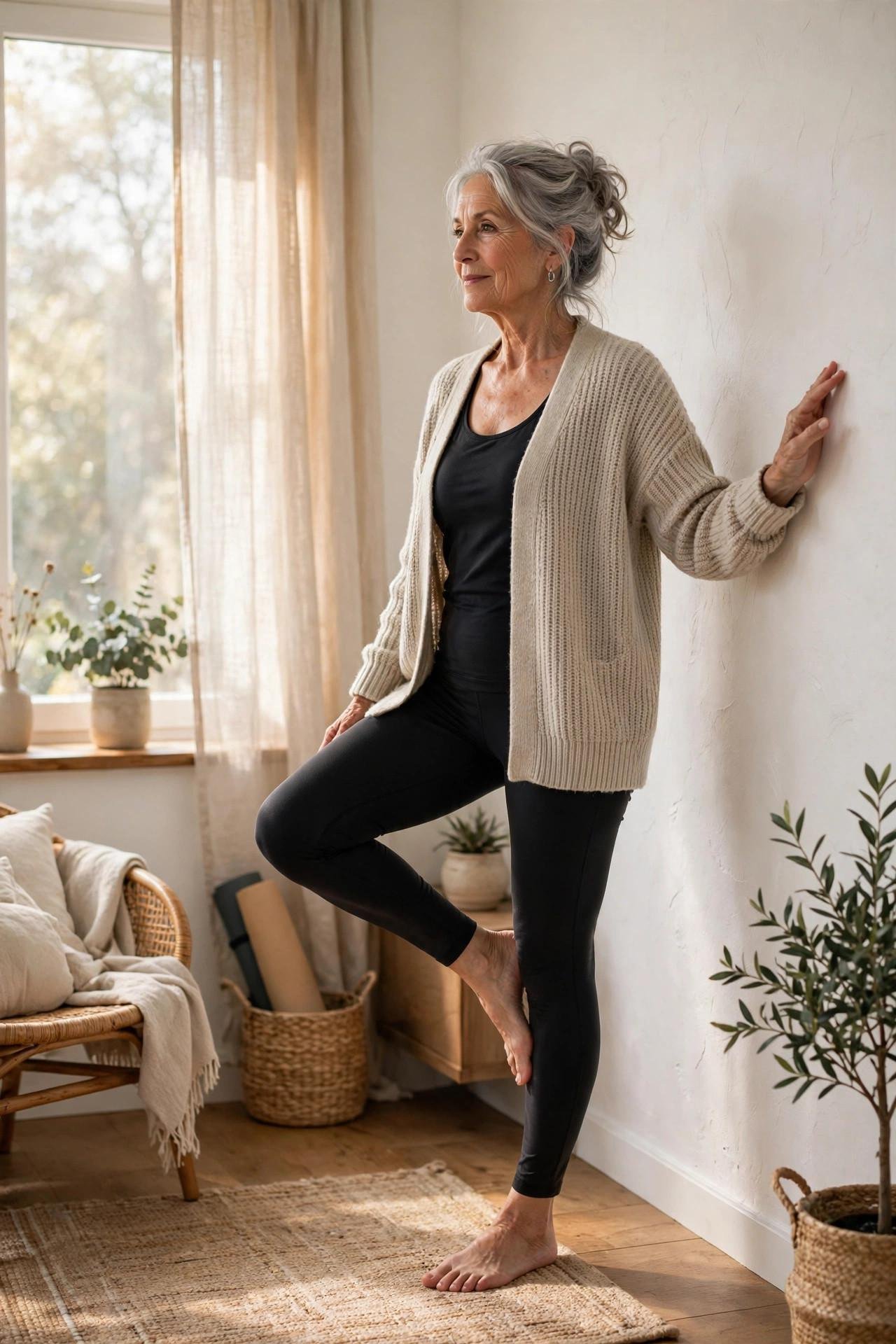
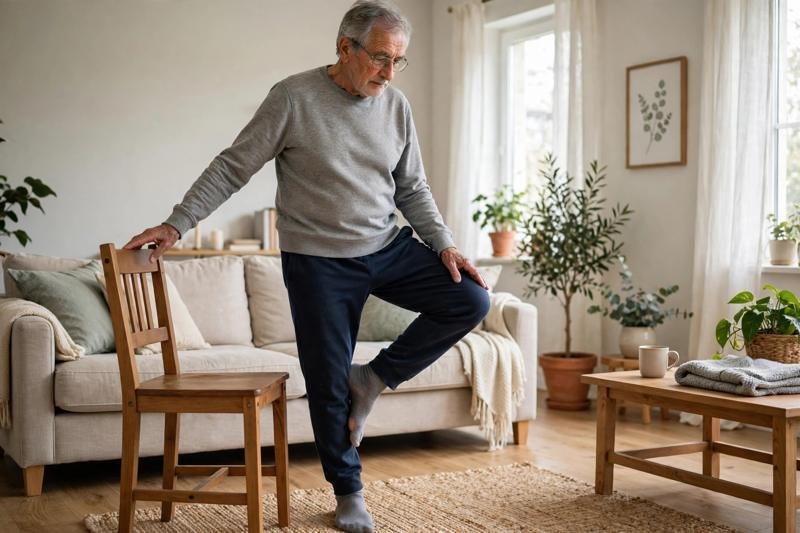
Tree pose is the single most useful balance exercise for fall prevention, and the chair makes it safe. Stand beside your chair, holding its back with the hand nearest to it. Shift your weight onto the foot farther from the chair, and place the other foot low, with the sole resting against your ankle or lower calf, never pressed against the knee joint. Keep your standing knee soft and your spine tall, and fix your eyes on one steady point ahead of you.
Hold for 10 to 20 seconds to start, then repeat on the other side. A wobble is not a failure; it is your balance system learning. Over weeks, try holding a little longer, or resting only fingertips on the chair. Never force the foot higher than your ankle or calf.
Minutes 10 to 14: Warrior II and Supported Triangle
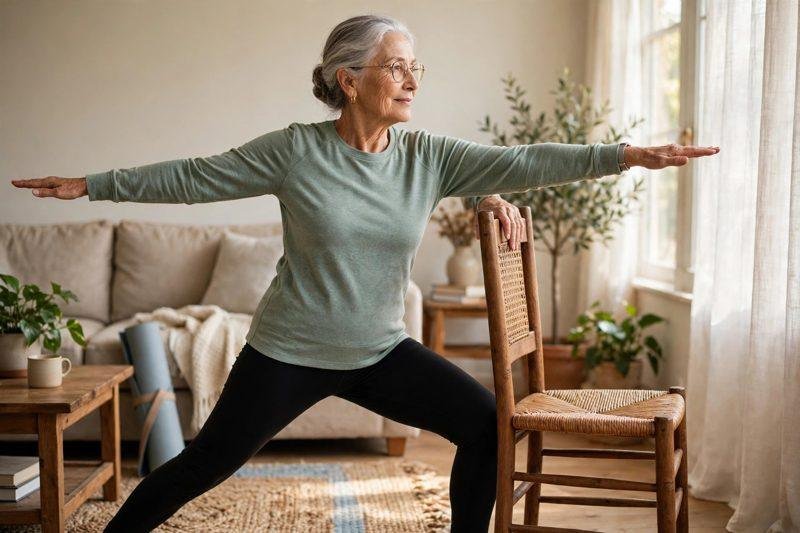
Warrior II builds leg and hip strength exactly where fractures hurt most. Stand beside your chair, step your feet wide apart, turn one foot out, bend that knee gently over the ankle, and extend your arms to the sides at shoulder height, palms down. Keep your spine tall. Hold for 20 to 30 seconds, then repeat on the other side.
For a supported triangle, stand with feet wide, one hand on the chair seat or your thigh, and reach the other arm up while keeping your spine long and chest open. Do not collapse sideways or round forward to reach lower. Hold for 20 seconds per side.
Minutes 14 to 17: Gentle Back Strength
Strong muscles along the spine help hold you upright and protect your posture. If getting onto the floor feels safe and you can get back up easily, lie on your back with knees bent and feet flat, then press gently through your feet to lift your hips a few inches into a small bridge. Hold for five breaths, lower slowly, and repeat three times. Keep the lift small; a high bridge is not the goal.
If floor work is not comfortable, do the seated version: sit tall, press your feet into the floor, and gently squeeze your shoulder blades together while lifting your chest a little. Hold for five breaths, repeat three times.
Minutes 17 to 20: Calming Breath and Rest
Return to your chair and sit tall, hands resting in your lap, eyes closed or softly lowered. Breathe in for four counts and out for six counts, repeating four rounds. Then sit quietly for one full minute, breathing naturally, letting your shoulders, jaw, and hands feel heavy. Rise slowly using the chair for support, and stand still for a few breaths before walking away, since standing up too quickly can cause lightheadedness.
Everyday Habits That Support Your Bones
The routine helps most when the rest of your day supports it. Walk regularly, even in short bursts, since walking is weight-bearing too. Make your home fall-proof: remove loose rugs and trailing cords, add night-lights on the path to the bathroom, and keep everyday items within easy reach. When you lift something, hinge from your hips with a long spine and bend your knees, keeping the object close to your body.
Common Mistakes to Avoid
The most common mistake is copying a general yoga video: many popular routines include deep forward folds, seated twists with a rounded back, sit-ups, and plough pose, all unsafe for fragile bones. Practicing in socks on a smooth floor is another fall risk, as is pushing into pain to “get deeper” into a pose; with osteoporosis, the goal is steady loading, not depth. Finally, benefits come from regularity over months, not from a single heroic session.
How Often Should You Practice?
Aim for three to five days a week to start, building toward most days if you enjoy it. The routine is gentle enough for regular practice, and short sessions done often beat long sessions done rarely. If daily practice feels like too much, start with three days and add a day whenever it feels easy. If you miss a day, simply return the next day without trying to make up for it by doubling the routine.
Frequently Asked Questions
Is yoga safe if I have osteoporosis?
Gentle, bone-safe yoga is often recommended for people with osteoporosis, but only in its adapted form. This routine avoids the movements most likely to harm fragile bones: rounded forward bending, forceful twisting, sit-ups, and inversions. Check with your healthcare professional before starting, especially if you have had a fracture.
Can yoga rebuild my bones?
Yoga alone cannot be relied on to reverse osteoporosis, and you should be wary of any program that promises it. Weight-bearing movement works best alongside your doctor’s medical care and medication plan.
What if I cannot stand for long?
Do the seated and wall-supported versions of every pose, and keep sessions shorter. You can build standing time gradually over weeks.
What if a pose hurts?
Stop that pose, soften it, or skip it entirely. Sharp, sudden, or lingering pain means the move is too much for you today.
What yoga poses should I avoid with osteoporosis?
Avoid any pose that rounds your spine forward under load: deep standing and seated forward folds, toe touches, sit-ups, and crunches. Also skip full shoulderstand, plough pose, and headstand, which load the neck and upper back, and avoid strong twists taken to the end of your range. These movements can squeeze the front of fragile vertebrae, so the safe rule is to keep your spine long and bend from the hips instead.
Which yoga poses are safest for osteoporosis?
Standing poses are the safest place to start, because they load your bones without bending your spine in risky ways. Mountain pose, warrior poses, and supported tree pose build leg and hip strength and train balance, which are the two things that most reduce fracture risk. Gentle back-strengthening moves, like a small bridge or squeezing your shoulder blades together while sitting tall, are also good choices. Use a chair or wall for support, and keep every movement slow and controlled.
Is yoga or walking better for osteoporosis?
Both help, and they do different jobs, so the best answer is usually both. Walking is simple weight-bearing exercise that loads your hips and legs with every step, while yoga adds balance training, posture, and muscle strength that walking alone does not give. Neither one replaces the medical care your doctor recommends, and neither can be relied on to rebuild bone on its own. A mix of regular walking and a few days of bone-safe yoga each week is a practical combination for most people.
Can I follow a general yoga class if I have osteoporosis?
A general class is risky, because many popular routines include exactly the movements fragile bones should avoid: deep forward folds, seated twists with a rounded back, sit-ups, and plough pose. A class designed for seniors or for bone health, taught by a teacher who understands osteoporosis, is a much safer choice. If you do join a general class, tell the teacher about your diagnosis before it starts, and be ready to skip or soften any pose that rounds your spine.
Can I do yoga if I have already had a fracture?
Often yes, but only with your doctor’s clearance and within the movement limits they set. After a fracture, your bones and the muscles around them need time to heal, and some movements may stay off-limits for a while. Start with the gentlest seated and supported versions, keep your spine long, and work with a teacher or physical therapist who knows your history. Stop and seek advice if any pose causes sharp or sudden pain.
The National Institute on Aging recommends weight-bearing exercise, such as walking and strength training, to keep bones strong, and exercise to improve strength and balance to help prevent falls — both fit naturally into yoga for seniors with osteoporosis.
A Gentle Closing
Gentle yoga for seniors with osteoporosis is not about becoming flexible or athletic. It is about a kind, predictable daily routine: standing tall under your own weight, strengthening the muscles that hold you upright, practicing balance with a chair nearby, and keeping your spine long.
Start today, if you like: stand behind your sturdy chair, hold its back lightly, and stand tall in mountain pose for 30 seconds, breathing steadily. That alone is a beginning, and it is a safe one.
If you found this routine helpful, you may also enjoy our gentle morning stretches, our evening yoga routine, our chair yoga routine for seniors, our gentle yoga routine for seniors with arthritis, and our gentle yoga routine for seniors with back pain, and you can learn more about this site on our About page, reach us through our Contact Us page, or read our Privacy Policy and Disclaimer.