

Introduction
If your knees ache when you climb stairs, stand up from a chair, or walk to the mailbox, you are not alone. Knee pain is one of the most common reasons people over 60 slow down, often from osteoarthritis, wear and tear, an old injury, or weak muscles around the knee. The pain can make you want to move less, but moving less makes knees stiffer and weaker.
This gentle yoga for seniors with knee pain breaks that cycle safely. It uses slow, low-impact movements, chair support, and seated exercises to strengthen the muscles around the knee and ease stiffness, without deep squats or kneeling. The routine takes about 20 minutes at home, and every pose can be softened, supported, or skipped.
What Is Yoga for Seniors with Knee Pain?
Yoga for seniors with knee pain adapts traditional yoga to knees that are stiff, sore, or affected by osteoarthritis. In a healthy knee, smooth cartilage cushions the joint and strong muscles in the thighs, hips, and calves share the load of every step. When cartilage thins with age or the supporting muscles weaken, more load lands directly on the joint, which is why stairs and standing up can hurt.
The goal of a knee-friendly practice is different from a general yoga class: it is not about deep flexibility or impressive poses. It is about building up the quadriceps, hamstrings, glutes, and calves that support the knee, keeping the joint moving gently, and improving balance. Movements stay slow and controlled, the knee is never forced past its comfortable bend, and a chair is always within reach.
How Gentle Yoga Helps Sore Knees
A short, regular practice helps in several practical ways:
- Strengthens the muscles around the knee. Stronger quadriceps and hamstrings act like a brace for the joint, taking pressure off it with every step.
- Eases stiffness. Gentle movement moves fluid through the joint, which is why knees often feel looser after a few minutes of easy motion.
- Improves flexibility. Slow stretches for the calves, hamstrings, and hips reduce tightness that pulls the knee out of alignment.
- Trains balance. Standing with chair support teaches your ankles and legs to react faster, which helps prevent falls.
- Reduces swelling and aching. Regular gentle movement supports circulation around the joint instead of letting it stiffen up from sitting.
Yoga cannot rebuild worn cartilage or cure osteoarthritis. Its value is steadier, stronger legs, less stiffness, and knees that cope better with daily life.
Who Can Do This Routine?
This routine is designed for adults 60 and older with mild to moderate knee pain, including osteoarthritis, general stiffness, or weakness after a period of inactivity. It suits you if you can sit and stand with support. Many exercises are done seated, so it also works well if standing for long is difficult.
It is not a substitute for medical care. Before starting, talk with your healthcare professional, especially if your knee is swollen, hot, or red, if it locks, catches, or gives way, or if you have had a recent knee injury or knee replacement. This article is educational only and is not medical advice, and any movement limits your doctor or physical therapist gave you come first.
Safety First: Knee-Safe Rules for Every Session
Keep these rules in place every time you practice:
- Never force the knee into a deep bend. Skip deep squats, kneeling, and sitting back on your heels. Bend only as far as feels comfortable, never through sharp or catching pain.
- Keep the knee tracking over the foot. When you bend your knee, it should point the same way as your toes, never collapsing inward.
- Do not twist on a bent knee. Avoid pivoting while your knee is bent and loaded; step around instead.
- Keep a chair or wall within reach. A chair back or a wall turns a wobble into a non-event.
- Move only to mild sensation, never sharp pain. A gentle effort in the muscles is fine. Sharp, stabbing, catching, or sudden knee pain means stop that move right away.
- Stop if your knee swells, locks, or gives way. Sit down, rest, and seek medical attention if it does not pass quickly.
- Breathe normally and move slowly. Never hold your breath, and avoid bouncing or jerking.
- Wear supportive, non-slip footwear or bare feet on a non-slip surface. Socks on a smooth floor are a fall risk.
- Skip any move that hurts the next day. Mild muscle warmth is normal, but knee pain lingering more than a day means that move was too much, so soften it or drop it.
The 20-Minute Knee-Friendly Routine
You need only a sturdy, armless chair, a non-slip mat, a small rolled towel, and comfortable clothing. Clear the floor of rugs, cords, and clutter before you begin.
Do this routine once a day, ideally late morning when your knees feel loosest. Move slowly, rest whenever you need to, and hold each pose for 20 to 30 seconds to start. If a move hurts, skip it and try again another day.
Minutes 0 to 3: Arrive, Breathe, and Warm the Knees
Sit toward the front half of your chair, feet flat on the floor, hip-width apart, hands on your thighs. Breathe in through your nose for four counts, out through your mouth for six. Repeat five times.
Now warm up the knees. Keeping your feet on the floor, slowly lift one heel, then the other, as if marching in place while seated, for one minute. Then slowly straighten one leg out in front of you, hold for three seconds, and lower it. Repeat five times per leg.
Minutes 3 to 7: Seated Knee Extensions and Heel Slides
Seated knee extensions are one of the best knee-friendly yoga poses for building strength without standing. Sit tall, hands resting on the seat or your thighs. Slowly straighten one leg until the knee is almost straight, tighten the thigh muscle at the top for three seconds, then lower the foot slowly. Do 8 repetitions per leg.
Next, heel slides. Sit tall with both feet flat. Slowly slide one heel forward along the floor until the leg is nearly straight, then slide it back, moving only as far as feels comfortable. Do 8 slow slides per leg.

Minutes 7 to 11: Supported Mountain Pose and Gentle Chair Pose
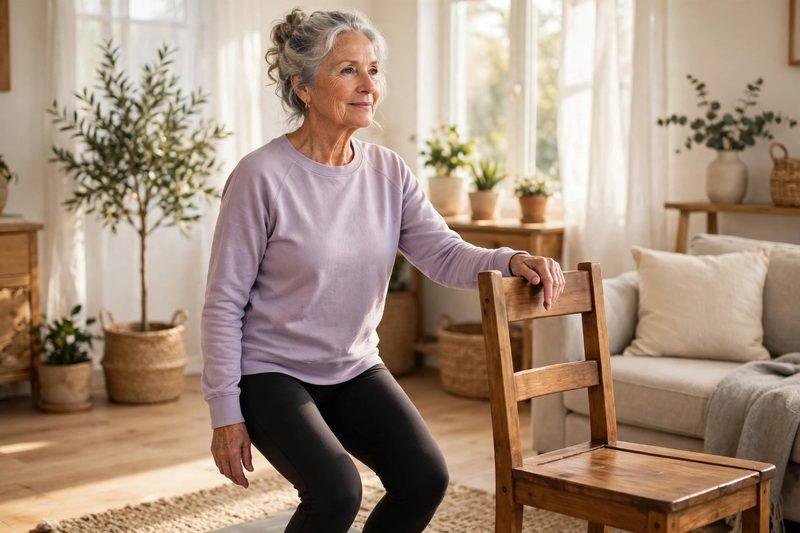
Stand behind your chair and hold its back lightly with both hands. This is mountain pose: feet hip-width apart, weight even, knees soft and never locked, spine tall. Breathe steadily for 30 seconds.
Now try a gentle chair pose with support. Keep your hands on the chair back, feet hip-width apart, and bend your knees slightly, as if you are about to sit down, but only a few inches, never into a deep squat. Hold for 10 to 15 seconds, then rise slowly. Repeat three times. This small bend strengthens the quadriceps, the muscles that do the most to protect the knee.
Minutes 11 to 15: Supported Tree Pose and Small Bridge
Tree pose is a useful balance exercise, and the chair makes it safe for sore knees. Stand beside your chair, holding its back with the hand nearest to it. Shift your weight onto the foot farther from the chair, and place the other foot low, sole resting against your ankle or lower calf, never against the knee joint. Keep your standing knee soft and your spine tall, eyes on one steady point ahead. Hold for 10 to 20 seconds, then repeat on the other side.
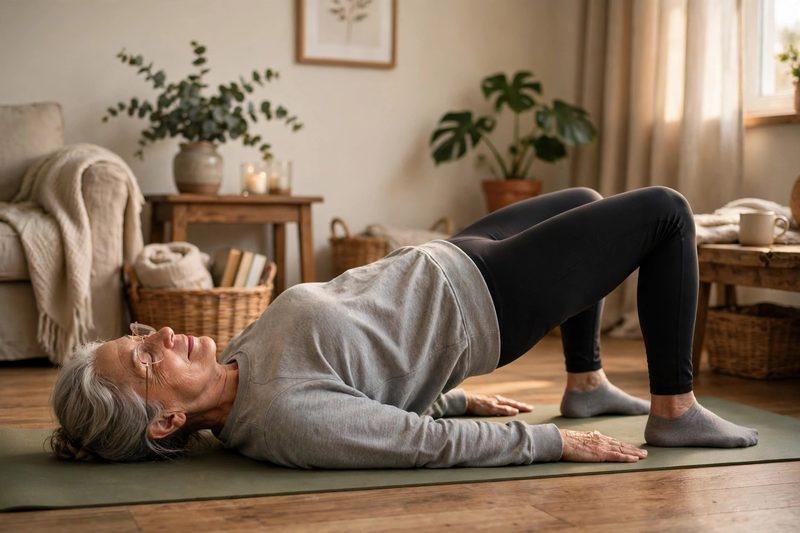
Then, if lying on the floor feels safe and you can get back up easily, lie on your back with knees bent and feet flat. Press gently through your feet to lift your hips a few inches into a small bridge, hold for five breaths, and lower slowly. Repeat three times. The bridge strengthens the glutes and hamstrings, which steady the knee from behind. If floor work is not comfortable, sit tall, squeeze your buttocks together for five seconds, release, and repeat five times.
Minutes 15 to 18: Gentle Stretches for Calves, Hamstrings, and Hips
Tight calves and hamstrings pull on the knee, so a few easy stretches finish the work. While seated, straighten one leg in front of you, heel on the floor, toes pointing up, and lean forward very slightly from your hips with a straight back until you feel a gentle stretch behind the knee. Hold for 20 seconds per leg.
Then stand behind your chair, hold its back, and step one foot back with the heel on the floor, keeping the back leg straight and the front knee slightly bent, feeling a gentle calf stretch. Hold for 20 seconds, then switch sides. Finally, sit tall and gently hug one knee toward your chest, holding for 15 seconds per side, only as far as it feels comfortable.
Minutes 18 to 20: Calming Breath and Rest
Return to your chair and sit tall, hands in your lap, eyes closed or softly lowered. Breathe in for four counts and out for six, repeating four rounds. Then sit quietly for one full minute. Rise slowly using the chair for support, and stand still for a few breaths before walking away.
Everyday Habits That Support Your Knees
The routine helps most when the rest of your day supports it. Walk regularly, even in short bursts, since walking keeps the joint moving and the muscles engaged. Keep your weight steady if your doctor has advised it, since every extra pound adds load to the knees. Make your home fall-proof: remove loose rugs and trailing cords, add night-lights on the path to the bathroom, and keep everyday items within easy reach.
Common Mistakes to Avoid
The most common mistake is copying a general yoga video: many popular routines include deep squats, kneeling lunges, lotus pose, and sitting back on the heels, all of which load a sore knee hard. Another is pushing into pain to get deeper into a pose; with knee pain, the goal is steady strengthening, not depth. Practicing in socks on a smooth floor is a fall risk, as is twisting on a planted foot. Finally, benefits come from regularity over weeks, not from a single heroic session.
How Often Should You Practice?
Aim for three to five days a week to start, building toward most days. Short sessions done often beat long sessions done rarely. If daily practice feels like too much, start with three days and add a day whenever it feels easy. If you miss a day, simply return the next day without doubling the routine.
Frequently Asked Questions
Is yoga good for seniors with knee pain?
Gentle, knee-friendly yoga can help many seniors, especially when the cause is osteoarthritis or weak supporting muscles. It strengthens the muscles around the knee, improves flexibility, and eases stiffness. It is not a cure, so check with your healthcare professional first.
What poses should I avoid with knee pain?
Avoid deep squats, kneeling poses, lotus and half-lotus, sitting back on your heels, and any pose that twists a bent knee. Skip any pose that causes sharp, catching, or lingering pain, and choose chair-supported or seated versions instead.
What if I cannot stand for long?
Do the seated versions of every exercise, especially the seated knee extensions and heel slides, and keep sessions shorter. Build standing time gradually, always with a chair nearby.
What if a pose hurts my knee?
Stop it, soften it, or skip it entirely. Sharp, catching, or lingering pain means the move is too much for you today. Mild muscle effort in the thigh is fine; pain inside the joint is not.
Can I do yoga if I have severe knee arthritis or a meniscus tear?
Gentle yoga can still help, but this is one situation where you should check with your doctor or physical therapist first. Start with chair-supported and seated exercises, such as seated knee extensions and heel slides, and avoid deep bends, kneeling, and lotus pose until you have medical clearance. A mild effort in the thigh muscles is fine, but sharp pain, catching, or locking inside the joint means the move is too much for your knee today.
What is the best yoga pose for knee pain?
Seated knee extensions are one of the most useful, because they strengthen the quadriceps — the muscles that do the most to protect the knee — without loading the joint. Sit tall, slowly straighten one leg until the knee is almost straight, tighten the thigh for three seconds, then lower the foot slowly. A small supported bridge is another good choice, since it builds the glutes and hamstrings that steady the knee from behind. Start with a few repetitions and build up slowly over weeks.
How long does it take for yoga to ease knee pain?
Most people notice their knees feeling a little looser within the first couple of weeks, but real improvements in strength and everyday movement usually take eight to twelve weeks of regular practice. Research on yoga for knee osteoarthritis found the clearest gains after a few months of steady practice, and the benefits faded when people stopped. Practising three to five days a week and judging progress by everyday things — stairs, standing up, walking further — is the most honest way to track it.
Can I do yoga after a knee replacement?
Many people use gentle, chair-supported yoga to rebuild strength and movement after a knee replacement, but only with their surgeon’s approval and within the movement rules they were given. Your surgeon or physical therapist will know which bends and positions are safe for your new joint and when it is time to start. Until you have that clearance, stick to the exercises from your recovery plan, and skip any pose that causes sharp pain, swelling, or a feeling that the knee might give way.
Should I do yoga when my knee is swollen?
No — a hot, red, or swollen knee is a sign to rest the joint and seek medical advice before starting or continuing a routine. Swelling can mean a flare-up, an injury, or an infection, and exercising through it can make things worse. Wait until the swelling and heat have settled, then return gently with the seated exercises and short sessions. If the swelling keeps coming back, or the knee locks or gives way, see your doctor.
The NHS notes that knee pain can often be treated at home and should begin to feel better within a few days, but advises seeing a GP if it does not improve within a few weeks — worth remembering as you build a yoga for seniors with knee pain routine.
A Gentle Closing
Gentle yoga for seniors with knee pain is not about becoming flexible or athletic. It is about a kind, predictable daily routine: strengthening the muscles that protect your knees, moving the joint gently, and practicing balance with a chair nearby.
Start today: sit in your sturdy chair, slowly straighten one leg, tighten your thigh for three seconds, and lower it. Repeat five times per leg. That alone is a beginning, and it is a safe one.
If you found this routine helpful, you may also enjoy our gentle morning stretches, our evening yoga routine, our chair yoga routine for seniors, our gentle yoga routine for seniors with arthritis, our gentle yoga routine for seniors with back pain, and our gentle yoga routine for seniors with osteoporosis, and you can learn more about this site on our About page, reach us through our Contact Us page, or read our Privacy Policy and Disclaimer.