

Introduction
If your back aches when you get out of bed, stiffens after sitting too long, or complains every time you bend to tie your shoes, you are far from alone. Back pain is one of the most common complaints after 60, and it often comes from the same everyday causes: weak core and back muscles, tight hips and hamstrings, hours spent sitting, and posture that slowly rounds forward over the years. This gentle yoga for seniors with back pain is built for that reality.
This guide offers a calm 20-minute routine of yoga for seniors with back pain you can do at home, mostly seated in a chair or standing with a chair for support. There is no floor work, no deep bending, and no pushing through pain. Every movement is slow, small, and easy to soften or skip.
What Is Gentle Yoga for Seniors with Back Pain?
Gentle yoga for seniors with back pain adapts traditional yoga to backs that are stiff, tender, or easily irritated. Instead of deep stretches or advanced poses, it uses slow spinal movement, supported standing poses, and breathing that helps tight muscles let go. The spine moves in all its natural directions, a little at a time: arching gently, rounding gently, twisting gently, and lengthening tall.
Unlike a vigorous exercise class, this practice never asks you to force a stretch. Forcing is often what makes a sore back worse. Small movements done regularly beat one heroic session that leaves you sore for days.
Benefits of a Gentle Back-Friendly Practice
A short, regular practice can help in practical, everyday ways:
- Eases morning stiffness. Slow spinal movement warms the muscles and joints around the spine, loosening the stiffness that builds up overnight.
- Improves spinal flexibility. Gentle arching, rounding, and twisting keep the spine mobile, so turning, reaching, and bending feel easier.
- Strengthens the muscles that support your back. A stronger core, stronger glutes, and stronger upper-back muscles take pressure off the spine itself.
- Improves posture. Sitting tall and opening the chest counteracts the rounded shoulders and forward head that come from years of sitting.
- Loosens tight hips and hamstrings. Tight hips and hamstrings pull on the lower back; easing them often eases the back too.
- Calms stress and tension. Slow breathing helps tense back muscles relax, and relaxed muscles hurt less.
- Builds confidence in movement. When you learn which movements feel safe, you stop guarding your back all day, and everyday tasks feel less frightening.
These benefits come from consistency, not intensity.
Who Can Do This Routine?
This yoga for seniors with back pain routine is designed for adults 60 and older with common, everyday back stiffness or mild, aching lower back pain, including complete beginners. It works well if your back stiffens after sitting, aches first thing in the morning, or feels tight after gardening or housework.
It is not designed for everyone. If your back pain shoots down your leg, causes numbness or weakness, followed a fall or injury, or is getting worse rather than better, talk with your healthcare professional before starting any exercise routine. This article is educational only and is not medical advice.
Safety First: Back-Friendly Rules for Every Session
Safety comes before any pose, especially with a sore back. Keep these rules in place every time you practice:
- Move only to mild sensation, never sharp pain. A gentle stretch is fine. Sharp, shooting, or stabbing pain means stop that move right away.
- Stop if you feel dizzy, short of breath, or have chest discomfort. Sit down, rest, and seek medical attention if the feeling does not pass quickly.
- Never force a stretch or twist. If your back does not want to move in a certain direction today, do not push it. Choose the easier version instead.
- Keep movements slow and smooth. No bouncing, jerking, or sudden twists. Your back likes slow, predictable movement.
- Keep a sturdy chair nearby. Even for standing moves, a chair gives you something solid to hold, so balance is never a worry.
- Breathe normally. Never hold your breath during a stretch. If you cannot breathe comfortably in a pose, ease out of it.
- Warm up first. Start with the smallest movements and build up slowly. A cold, stiff back dislikes sudden effort.
- Skip any move that hurts the next day. Mild muscle warmth after practice is normal; pain that lingers into the next day means that move was too much, so soften it or drop it.
What You Need
You need very little, and you probably already own all of it: a sturdy, armless chair with a firm seat, a small cushion or folded towel for your lower back, and comfortable, loose clothing.
The 20-Minute Back-Friendly Routine
Do this yoga for seniors with back pain routine once a day, ideally in the morning after a warm shower or after your back has loosened a little, or in the early evening if mornings are your stiffest time. Move slowly, breathe through your nose when you can, and rest whenever you need to.
Minutes 0 to 3: Arrive, Breathe, and Sit Tall
Sit toward the front half of your chair with both feet flat on the floor, hip-width apart. Place your hands on your thighs and close your eyes if that feels comfortable, or soften your gaze toward the floor.
Breathe in slowly through your nose for a count of four, then breathe out slowly through your mouth for a count of six. Repeat five times. Longer exhales are the simplest way to tell tight back muscles to let go.
Now find your tall sitting posture, which is itself a back exercise. Imagine a string gently pulling the top of your head toward the ceiling. Let your shoulders roll back and down, your chin level, and your lower back in its natural gentle curve. Sit tall for five slow breaths.
Minutes 3 to 6: Seated Cat-Cow and Gentle Side Bends

Seated cat-cow is the single most useful movement for a stiff back, and it is worth doing every day. Sit tall with your hands on your knees. On an inhale, gently arch your back, lift your chest, and look slightly upward. On an exhale, round your back, tuck your chin, and let your shoulders curl forward. Move back and forth slowly, eight times, matching each movement to one breath.
Next, add a gentle side bend. Sit tall, rest your left hand on the chair seat beside you, and reach your right arm up and slightly over to the left, as if reaching for something on a high shelf to your left. You should feel a mild stretch along your right side, from hip to ribs. Hold for three breaths, return to center, and repeat on the other side. If a side bend pinches, make it smaller or skip it.
Minutes 6 to 9: Seated Spinal Twists
Twists keep the spine mobile and ease the stiffness that builds up from sitting in one position all day. Keep both feet flat and your hips facing forward. Place your right hand on the outside of your left knee and your left hand on the chair behind you, or on your hip if reaching behind is uncomfortable. Inhale to sit tall, then exhale and turn gently to the left. Hold for three breaths, feeling the twist come from your mid-back rather than forcing it from your shoulders, then return to center and repeat on the other side.
A common mistake is twisting too hard. A gentle twist that you can breathe comfortably through does far more good than a forceful one.
Minutes 9 to 13: Hips, Hamstrings, and Glutes
Tight hips and hamstrings are quiet contributors to back pain, because when they cannot move, the lower back has to do their work.
For the seated figure-four stretch, place your right ankle on your left knee, keeping the foot flexed to protect the knee. Sit tall and lean forward very slightly from the hips until you feel a gentle stretch deep in the right hip and buttock. Hold for four breaths, then switch sides. If the ankle-on-knee position is uncomfortable, simply cross your ankles and lean forward slightly instead.
For the hamstrings, sit toward the front of your chair and extend your right leg forward, heel on the floor, toes pointing up, with a soft bend in the knee. Sit tall, then hinge forward very slightly from the hips until you feel a mild stretch behind the thigh. Hold for three breaths, then switch sides.
Finish with a gentle glute squeeze, which wakes up the muscles that support your lower back when you stand and walk. Sit tall with both feet flat, squeeze your buttocks together firmly for five seconds, then release completely. Repeat eight times.
Minutes 13 to 16: Supported Standing Strength
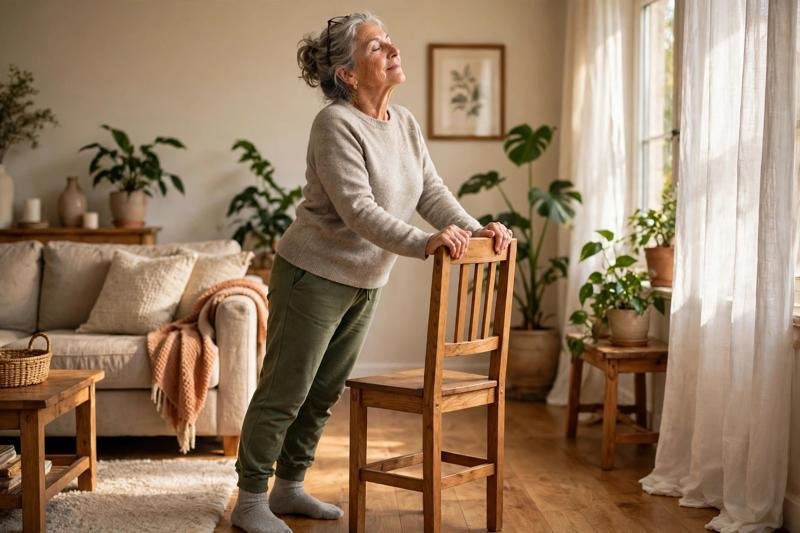
If standing feels safe for you today, stand behind your chair and hold its back lightly. This section builds the leg and core strength that protects your back during everyday tasks like standing up, walking, and carrying groceries.
First, the standing back stretch: hold the chair, step back slightly, and hinge forward from your hips just a little, keeping your back long and flat rather than rounded. Hold for three breaths, then stand tall again. Repeat three times.
Next, slow chair squats. Stand in front of your chair, feet hip-width apart, arms reaching forward for balance. Bend your knees and lower yourself slowly toward the chair, as if you were about to sit, then press through your feet and stand back up before you actually sit down. Do five, slowly. Strong legs mean your back does less lifting in daily life.
Minutes 16 to 20: Calming Breath and Rest
Return to your chair and sit tall, hands resting in your lap, eyes closed or softly lowered. Breathe in for four counts and out for six counts, repeating four rounds.
Finish by sitting quietly for one full minute, breathing naturally and letting your shoulders, jaw, and lower back feel heavy. Then rise slowly using the chair for support.
Everyday Habits That Protect Your Back
The routine helps most when the rest of your day supports it. Change position every 30 minutes if you sit for long stretches. When you lift something, bend your knees and keep the object close to your body rather than bending from the waist with straight legs. Sleep with a pillow between your knees if you sleep on your side, or under your knees if you sleep on your back. And several times a day, when you notice yourself slumping, gently sit tall for a few breaths before settling again.
How Often Should You Practice?
Aim for most days, five to seven days a week if you enjoy it. The routine is gentle enough for daily practice, and regularity is what turns it into a reliable stiffness-easer. If daily feels like too much, start with three days a week and add a day whenever it feels easy. If you miss a day, simply return the next day.
Frequently Asked Questions
Is yoga safe if I have a bad back?
Gentle, slow yoga is often recommended for common back stiffness, but it depends on the cause of your pain. This routine avoids deep bending, forceful twisting, and floor work, which are the moves most likely to irritate a sore back. If your pain shoots down your leg, causes numbness or weakness, or is getting worse, check with your healthcare professional before starting.
What if a pose hurts?
Stop that pose, soften it, or skip it entirely. A mild stretch is fine, but sharp, shooting, or pinching pain means the move is too much for your back today.
How long before my back feels better?
Many people notice less morning stiffness within a week or two of daily practice, but lasting change usually takes four to eight weeks of regular practice. Judge progress by everyday things: getting out of bed more easily, sitting more comfortably, or walking further before your back complains.
Is yoga good for back pain?
Yes, for most people with long-lasting, everyday lower back pain, gentle yoga for seniors with back pain is a good choice. Major guidelines list yoga among the first non-drug treatments to try, and studies have found it works about as well as physical therapy exercise for easing pain and improving movement. The benefit is usually modest rather than dramatic, and it builds over weeks of regular practice, so think of it as steady help rather than a quick fix. If your pain is new, severe, or follows an injury, check with your doctor first.
Which yoga poses should I avoid with back pain?
Skip deep forward folds with a rounded back, forceful twists, sit-ups, and any pose that sends pain down your leg. Deep backbends and fast, jerky movements can also irritate a sore back, especially during a flare-up. The safest approach is to keep your spine long, move slowly, and choose supported, gentle versions of each pose — if a movement pinches or shoots, leave it out for now.
Can yoga make back pain worse?
Yes, it can, usually when poses are pushed too far, done too fast, or copied from a general class that includes deep bends and twists. A small number of people notice a temporary flare of back pain after starting yoga, which normally settles within a day or two. To keep that risk low, move only to mild sensation, never sharp pain, and stop any pose that still hurts the next day. If pain keeps getting worse instead of better, pause the routine and talk with your doctor.
What type of yoga is best for back pain?
Gentle styles such as Hatha, restorative yoga, and Iyengar-style classes work best, because they move slowly, use props and chairs for support, and adapt poses to your body. Fast-flowing or hot yoga classes are a poor match for a sore back, since they move quickly and make it easy to push too far. If you join a class, tell the teacher about your back first, and choose one that welcomes beginners and older adults.
When should I see a doctor about back pain instead of doing yoga?
See a doctor promptly if your back pain follows a fall or accident, comes with fever or unexplained weight loss, is severe at night, or shoots down your leg with numbness or weakness. Also seek care if you develop new problems controlling your bladder or bowels, or if the pain keeps getting worse over days rather than easing. These signs need medical attention first, and yoga can wait until your doctor says it is safe to begin.
The American College of Physicians lists yoga among the non-drug treatments it recommends trying first for low back pain.
A Gentle Closing
Gentle yoga for seniors with back pain is not about becoming flexible or athletic. It is about giving a stiff back a kind, predictable daily routine: slow spinal movement, supported strength, tall posture, and calm breathing, all within a range that feels good.
Start today, if you like: sit in your sturdy chair, take five slow breaths, and move your spine gently through cat-cow eight times. That alone is a beginning.
If you found this routine helpful, you may also enjoy our gentle morning stretches, our evening yoga routine, our chair yoga routine for seniors, and our gentle yoga routine for seniors with arthritis, and you can learn more about this site on our About page, reach us through our Contact Us page, or read our Privacy Policy and Disclaimer.