

If you had a knee replaced and you miss moving the way you used to, yoga for seniors after knee replacement can help you get strength, bend, and balance back — but only if you work in the right order and leave out the poses that put your new joint at risk. This guide is for people 60 and over who are home from surgery and want a clear, week-by-week plan. It is general education, not medical advice. Your surgeon and physical therapist have the final word, so do not start any pose below until your team says you can.
What yoga can and cannot do after a knee replacement
Yoga will not fix a stiff knee on its own. Your prescribed physiotherapy does the heavy lifting in the first weeks: thigh squeezes, heel slides, and walking. Yoga adds three things. It builds the muscles that hold the knee steady — the front of the thigh, the back of the thigh, and the hips. It trains balance.
Here is what yoga cannot do. It cannot loosen a well-fixed knee replacement. That is the fear many people carry, and it is worth answering plainly: gentle, controlled poses do not pull an implant loose. Implants loosen from infection, from wear over many years, or from a bad fall — not from a slow chair pose.
Most people can bend a replaced knee to about 90 degrees by six weeks and to 110 to 120 degrees by three months, though the numbers vary a lot. The goal is a knee that straightens fully, bends enough to sit, stand, climb stairs, and walk without a limp, and a body that trusts the leg again.
The three rules that protect your new knee
Everything in this guide follows three rules. If a pose breaks one of them, skip it or change it.
Rule 1: No kneeling. Do not kneel on your new knee until your doctor says you can. For most people that is at least three months. Kneeling puts your full body weight through a small patch of skin and bone that is still healing. Until you are cleared, do every kneeling pose in a chair or standing instead.
Rule 2: No deep squats. A deep squat, a full chair pose, hero pose, or sitting back on your heels in child’s pose all force the knee past the bend it can safely give. Keep standing bends shallow — your knees bend to about 30 to 45 degrees at most in the first three months.
Rule 3: No twisting on a planted foot. Keep your foot and your knee pointing the same way. If your foot is stuck to the floor and your body turns, the twist goes straight into the knee. Step or lift your foot to turn instead. That means no pigeon pose, no lotus, no fire log pose, and no deep seated twist where you pull with your arms.
One more rule for the first six weeks: do not sit with your legs crossed, and do not sleep with a pillow under your knee. A pillow under the knee feels kind at night, but it trains the knee to stay slightly bent. Put the pillow under your ankle instead.
Before you begin: clearance, props, and costs
Get clearance first. Ask your surgeon two questions at your follow-up visit: “Which movements are off-limits for me, and for how long?” and “What bend should I aim for by my next visit?” Write the answers down. Surgeons differ — some clear gentle yoga at six weeks, others wait until three months.
What you need. A sturdy chair with a straight back and no wheels is the main prop. A yoga strap or a long belt costs about $8 to $12 and helps you stretch your leg without bending the knee too far. A firm cushion or folded blanket, about $10 to $15, goes under your heel for straightening work. All told, set-up costs $25 to $50.
When and how long. Plan on 15 to 20 minutes a day in the first six weeks, plus your prescribed physiotherapy and short walks. After six weeks, build to 25 to 30 minutes, three to five days a week. Short and daily beats long and rare: ten minutes every morning does more for your bend than one long hour on Sunday.
Weeks 1–2: straighten the knee, wake up the thigh
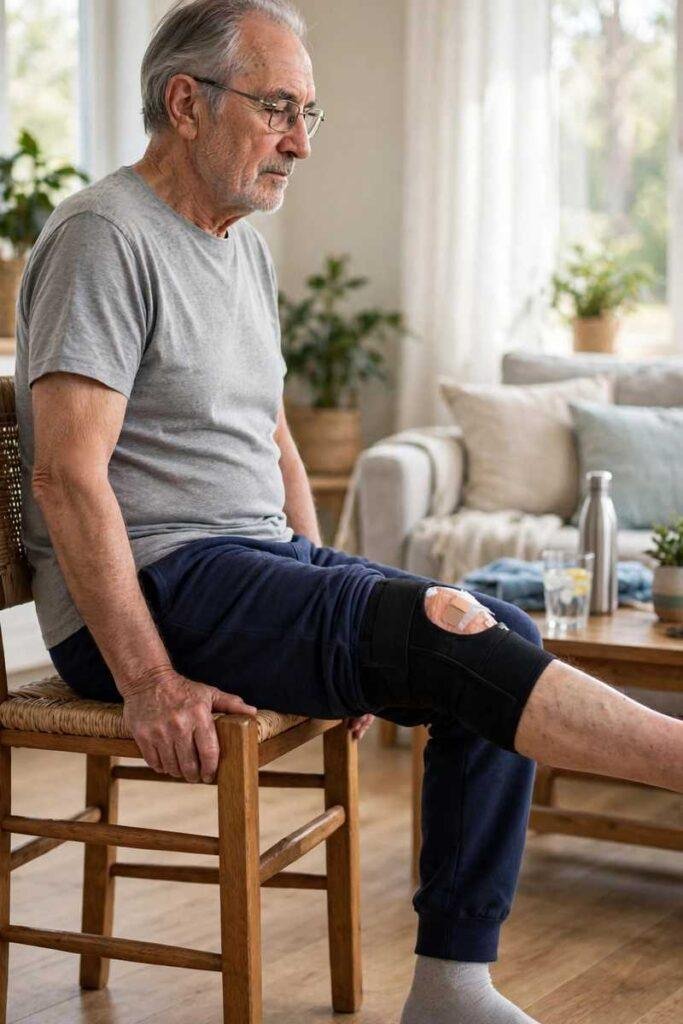
Your job in the first two weeks is simple: get the knee to straighten fully, wake up the thigh muscle, and keep blood moving. Do these on your bed or in your chair, two or three times a day. Breathe slowly through your nose, and stop any movement that gives sharp pain.
Thigh squeeze. Sit or lie with your leg straight. Press the back of your knee down into the bed or chair seat, as if you are trying to squash a grape under your knee. Tighten the front of your thigh hard. Hold for 5 to 10 seconds, then let go. Do 10 squeezes, rest for one minute, then do another 10.
Heel-prop straightening. Lie on your back and put a rolled-up towel under your ankle. Tighten your thigh and press the back of your knee toward the bed. Hold for 5 to 10 seconds, relax, and repeat for 3 minutes, twice a day.
Ankle pumps. Move your foot up and down at the ankle for 2 to 3 minutes, two or three times an hour while you are awake. It keeps blood moving and cuts swelling.
Weeks 3–6: bend the knee and get walking
Once your wound is closed and your team agrees, the work shifts to bending.
Heel slides. Lie on your back on the bed, both legs straight. Slowly slide the heel of your operated leg toward your buttock, bending the knee as far as it will go without sharp pain. Hold the deepest bend for 5 to 10 seconds, then slide the leg straight again. Repeat 10 times, twice a day.
Walking. Walking is the best exercise for a new knee, and it is the one people underdo. Walk for 10 minutes at a time, two or three times a day. Add five minutes a week. By week six, most people can walk for 20 to 30 minutes at a stretch.
Weeks 6–12: strength and balance
Once your surgeon clears it, yoga proper begins.
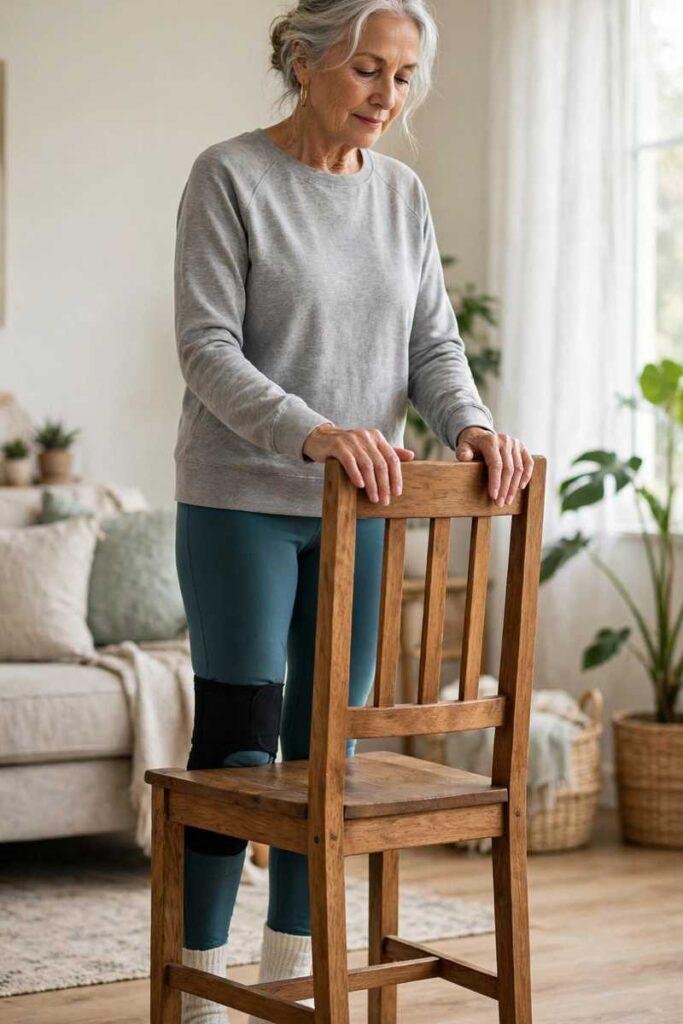
Supported mountain pose. Stand behind your chair, fingertips on the chair back. Feet hip-width apart, weight even across both feet. Tighten your thighs gently and stand tall, as if a string is pulling the top of your head upward. Hold for 30 seconds, breathing slowly.
Supported warrior II, shallow version. Stand sideways behind your chair, one hand on the chair back. Step your feet wide apart, about 3 feet. Turn your front foot out and your back foot slightly in — step the feet into position rather than twisting them on the floor. Bend your front knee to about 30 degrees, no more, and keep the knee pointing over the second toe, never collapsing inward. Hold for 15 to 20 seconds on each side, twice.
After three months: back to class
By three months, most people are walking well, bending to 110 degrees or more, and ready for a fuller class — with rules. Tell the teacher before your first class that you have a knee replacement, which knee, and the year it was done. Keep the three rules for life: no kneeling until your doctor clears it, no deep squats, no twisting on a planted foot.
The American Academy of Orthopaedic Surgeons publishes a free exercise guide for total knee replacement that lists the same early exercises your physiotherapist gave you, and it is a good reference to keep on hand: https://orthoinfo.org/en/recovery/total-knee-replacement-exercise-guide/
How often, and how to start this week
Start with 15 minutes a day, five days a week, and add five minutes each week until you reach 30 minutes. Do it at the same time each day so it becomes a habit.
Common mistakes that slow recovery
Pushing through sharp pain. A dull ache during a stretch is normal. Sharp pain, or pain that stays above a 3 out of 10 for more than an hour after you stop, means you pushed too far. Back off for two days, use ice, and try again more gently.
Skipping the straightening work. Everyone wants to work on the bend, because the bend is the number you can see. Do the heel-prop straightening every day, even after the bend feels fine.
Doing too much on a good day. The classic mistake is a good day followed by a long walk, a full class, and gardening.
Troubleshooting: what to do when things feel wrong
Your knee clicks. A soft click or clunk when you bend or straighten is common with a new knee and usually harmless. A click that comes with sharp pain, or with the knee catching and locking, is different: call your surgeon.
Your knee swells after a session. Some swelling after exercise is normal for the first three months. Raise your leg on pillows so the foot is above the heart, and put an ice pack wrapped in a towel on the knee for 20 minutes, then off for 20 minutes, for about two hours.
Stop and call your doctor: the red flags
Stop exercising and call your surgeon or your doctor straight away if you notice any of these: one calf that is hot, swollen, and painful while the other is fine; breathlessness or chest pain; a fever over 100.4°F (38°C); a wound that opens, leaks, or turns red and hot; or a knee that suddenly will not straighten when it could before. A hot swollen calf can mean a blood clot, and breathlessness with it needs emergency care.
Getting up from the floor safely
Here is the safe way, once your team clears floor work. Roll onto your side and onto your hands and knees — but only if your doctor has cleared kneeling; if not, skip floor work and stay in the chair. From hands and knees, bring your good leg forward and put that foot flat on the floor. Push through that foot and your hands on the chair seat to stand, keeping your operated leg straight and your weight on the good leg and the chair. Never twist your operated knee while you are getting up.
Frequently Asked Questions
How soon after knee replacement can I start yoga?
For actual yoga poses, most surgeons clear people between 6 and 12 weeks, and some wait until three months. Your own surgeon’s timing beats any timeline you read online, so ask at your follow-up visit.
Can I kneel in yoga after a knee replacement?
Not until your doctor says you can, and for many people that is three months or longer. Kneeling puts your full weight through the front of a healing knee, and it can be painful even when the joint is fine. Until then, do kneeling poses seated or standing.
Can yoga loosen my knee replacement?
No. Gentle, controlled yoga does not loosen a well-fixed implant. Implants loosen from infection, from wear over many years, or from a bad fall — not from slow poses with a chair for support.
Which yoga poses should I never do after a knee replacement?
Never do hero pose, lotus, pigeon, fire log, a full squat, or sitting back on your heels in child’s pose — all of them force the knee into a deep bend or a twist it cannot safely give. Skip deep lunges and any pose where you jump or bounce into position. Safe swaps: hero pose as a seated leg stretch with a strap, and child’s pose sitting tall in a chair with your arms stretched overhead.
How do I get up from the floor safely after a knee replacement?
Roll to your side, come onto your hands and knees only if your doctor has cleared kneeling, then bring your good leg forward, plant that foot flat, and push up through the good leg and a sturdy chair. Keep your operated leg straight while you rise and never twist it. If you are not cleared to kneel, skip floor work entirely and do your routine in a chair or on the bed instead. Ask your physiotherapist to show you the move in person once, so you know it feels safe before you try it alone.
Keep exploring more gentle routines for seniors: yoga for seniors with knee pain, yoga after hip replacement for seniors, yoga for seniors with arthritis, chair yoga for seniors, balance yoga for seniors, morning stretches for seniors, and bedtime yoga for seniors. You can also learn more on our About page or reach us through the Contact Us page, and read our Privacy Policy and Disclaimer.